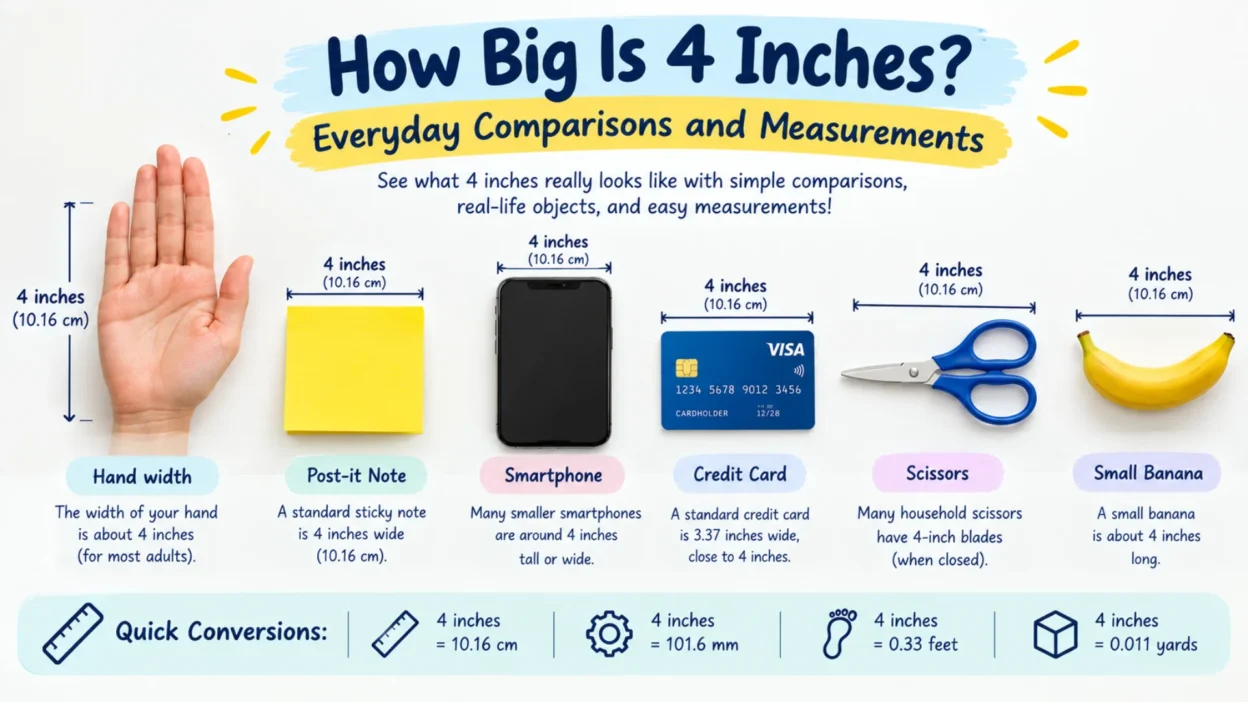
How big is 4 inches in real life? Four inches equals 10.16 centimeters, 101.6 millimeters, or one-third of a foot. It is a short distance that you can picture by comparing it with familiar household items.
This measurement can be useful when shopping online, organizing small spaces, choosing accessories, or working on craft projects. Knowing its size also helps you understand product descriptions that use inches instead of centimeters.
In this guide, you will learn how to visualize this length, convert it into different units, compare it with everyday objects, and estimate it without a ruler.
How Long Is 4 Inches?
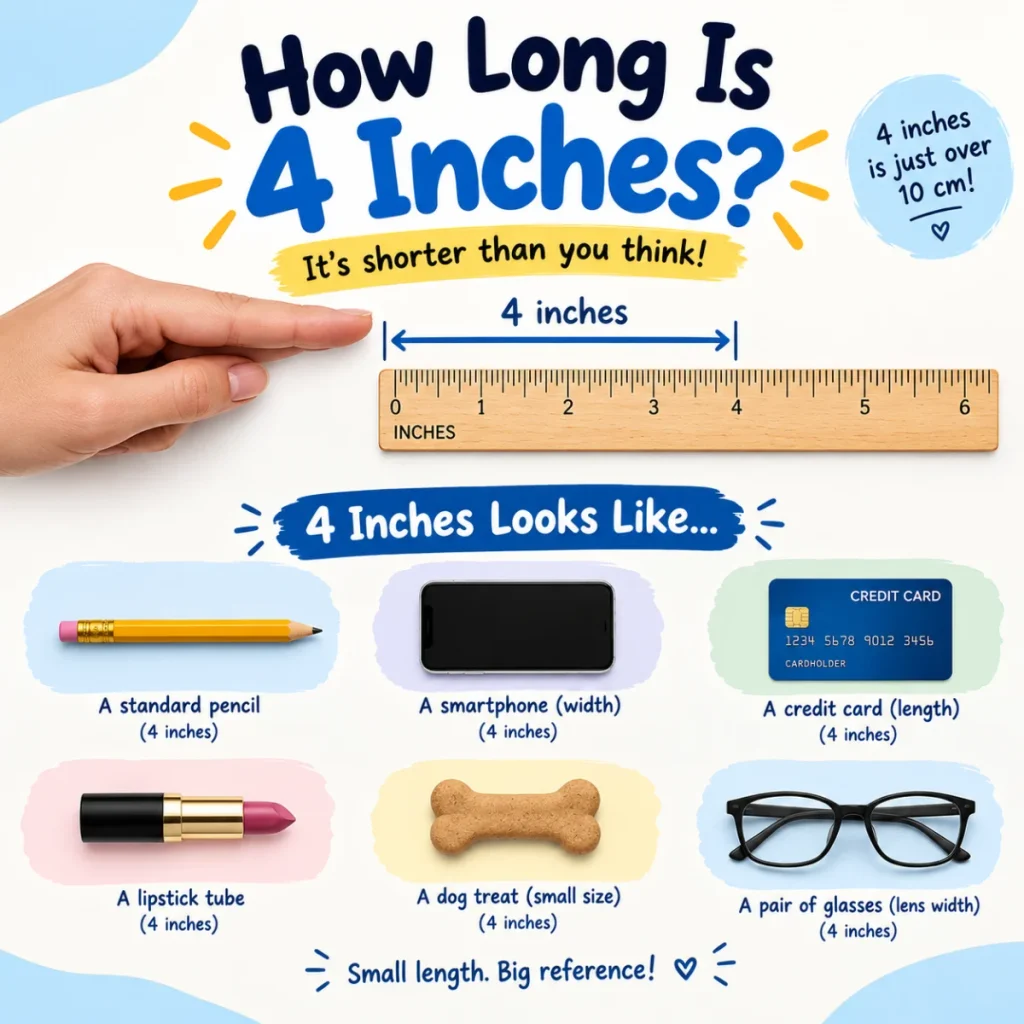
Four inches is the distance between the zero mark and the four-inch mark on a standard ruler. In metric units, it measures 10.16 centimeters.
That makes it slightly longer than 10 centimeters. The difference is only 1.6 millimeters, which is small enough to be difficult to notice without a measuring tool.
This length can describe the height, width, depth, or diameter of an object. For example, a small container might be four inches tall, while a round plate might have a diameter of four inches.
These measurements describe different dimensions, so it is important to check the details when comparing products. An item measuring four inches wide might be much longer in the other direction.
Four inches is also one-third of a foot because one foot contains twelve inches. Remembering this relationship makes it easier to estimate measurements when working with feet and inches.
4 Inches in Different Measurement Units
Converting inches into other units helps you understand measurements used in product listings, instructions, and everyday situations.
Here is a quick conversion chart.
| Unit | Equivalent |
|---|---|
| Inches | 4 inches |
| Centimeters | 10.16 cm |
| Millimeters | 101.6 mm |
| Feet | 0.3333 ft |
| Yards | 0.1111 yd |
| Meters | 0.1016 m |
The most useful conversion for everyday purposes is usually centimeters. Many international shopping websites list product dimensions in centimeters, while others use inches.
If a product measures 10.16 centimeters, its length is exactly four inches. A measurement of 10 centimeters is slightly shorter.
How to Convert Inches to Centimeters
One inch equals exactly 2.54 centimeters. To convert an inch measurement into centimeters, multiply the number by 2.54.
For four inches, the calculation is:
4 × 2.54 = 10.16 centimeters.
Therefore, four inches equals 10.16 cm.
You can use the same formula for other measurements. For example, two inches equals 5.08 centimeters, while six inches equals 15.24 centimeters.
How to Convert Inches to Millimeters
One inch equals 25.4 millimeters. Multiply four by 25.4 to calculate the metric equivalent.
4 × 25.4 = 101.6 millimeters.
Therefore, four inches equals 101.6 mm.
Millimeters are useful when measuring small parts, tools, hardware, and craft materials. If a product description lists a length of 101.6 millimeters, it represents the same distance.
How to Convert Inches to Feet
One foot contains twelve inches. To convert four inches into feet, divide four by twelve.
4 ÷ 12 = 0.3333 feet, approximately.
This means four inches is one-third of a foot. It is also eight inches shorter than a complete foot.
How to Convert Inches to Meters
One inch equals 0.0254 meters. Multiply four by this number to convert the measurement.
4 × 0.0254 = 0.1016 meters.
Therefore, four inches equals 0.1016 meters, which is slightly more than one-tenth of a meter.
What Does 4 Inches Look Like?
A measurement becomes easier to understand when you compare it with something familiar. Four inches is just over ten centimeters, making it suitable for visual comparisons with small household objects.
Imagine a straight line that measures ten centimeters and then extends another 1.6 millimeters. That is the approximate length you are trying to picture.
You can also use a ruler to see the distance directly. The space between its zero mark and the four-inch mark gives you an exact reference.
Keep in mind that visual comparisons are estimates unless you know the actual dimensions of the object. Items that appear similar in size can have different lengths, widths, and shapes.
8 Everyday Objects That Help You Visualize 4 Inches
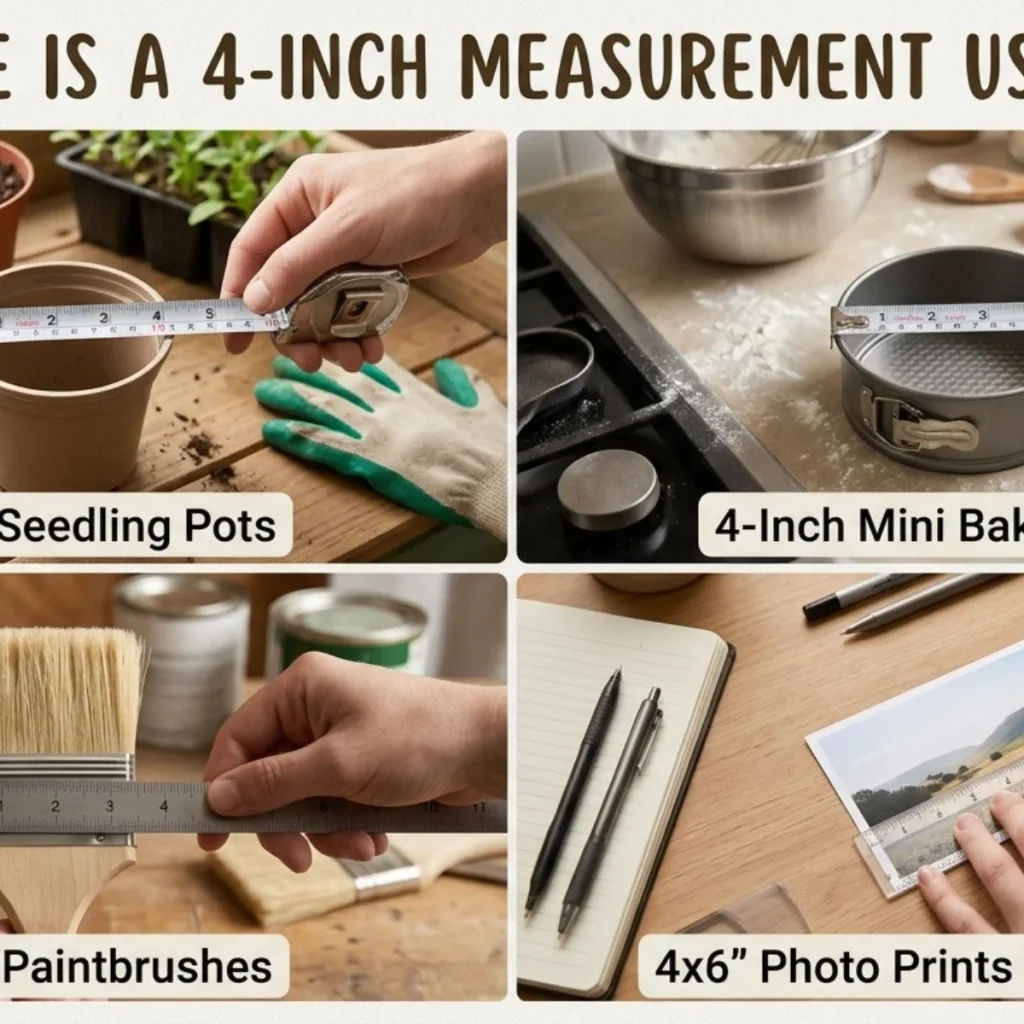
Everyday items can provide helpful references when you do not have a ruler nearby. The following examples may have a dimension close to four inches, but their actual sizes vary by model and design.
1. A Small Notebook
Some pocket notebooks have a width or height close to four inches. Their compact size makes them convenient for carrying in a handbag, backpack, or pocket.
However, notebooks come in different formats. Some are considerably smaller, while others are much wider and taller.
If you own a notebook, measure its height or width to see how closely it matches this length. Once you know its dimensions, you can use it as a personal reference.
2. A Smartphone’s Width
Four inches can help you picture the width of a larger smartphone, although many modern phones are narrower than this.
A phone’s body dimensions are different from its screen size. Screen measurements usually describe the diagonal distance between opposite corners of the display.
If you want to compare your phone with this measurement, check the manufacturer’s listed width. This gives you a more reliable comparison than estimating from the screen alone.
3. A Square Sticky Note
Some square sticky notes have sides close to four inches. Their simple shape makes them easy to compare with a straight measurement.
Smaller sticky notes are common, so do not assume every note has the same dimensions. Check the package if you need a close match.
A known-size note can be useful for small office projects, labeling, and basic craft activities.
4. A Small Plate
Some small plates measure around four inches in diameter, although many dessert and dinner plates are larger.
Diameter means the straight distance from one side of a circle to the opposite side, passing through its center. It does not describe the distance around the outside edge.
If you are buying a plate, check its listed diameter rather than relying on a photograph. Perspective can make an object look larger or smaller than it really is.
5. A Compact Kitchen Tool
Some small kitchen tools have a handle or overall length close to four inches. Their size depends on their design and intended use.
When checking a utensil, measure from its farthest point to the opposite end if you want the total length. If you only need the handle length, measure that section separately.
This distinction is useful when organizing kitchen drawers or choosing compact accessories.
6. A Small Wallet
Certain compact wallets have a height or width close to four inches. However, wallet dimensions vary according to their design and the items they are made to hold.
A wallet may be four inches wide but longer in the other direction. Its thickness is another separate measurement.
If you are purchasing a wallet online, check its complete dimensions to make sure it will fit comfortably in your pocket or bag.
7. A Miniature Picture Frame
Some miniature picture frames have one side measuring approximately four inches. They are often used for small photographs or desk decorations.
Be careful when reading product dimensions. The measurements might describe the outside of the frame rather than the size of the photograph it holds.
If the frame must fit into a specific space, check both the external dimensions and the picture opening.
8. A Small Storage Container
Some compact containers have a height, width, or depth close to four inches. They can be useful references when organizing small household items.
However, one container might be four inches tall but much wider. Always identify the dimension you want to compare.
If you need to fit a container inside a drawer, measure the available space first. Leave a little extra room if the container needs to slide in and out easily.
How Big Is 4 Inches Compared With a Hand?
Your hand can help you estimate short distances, but it is not a universal measuring tool. Hand sizes vary according to age, body proportions, and individual differences.
For some people, four inches may be close to the width of their palm. For others, it may be noticeably wider or narrower.
Finger length is also different from person to person. Using your thumb or index finger as an exact reference can lead to inaccurate estimates.
You can make this method more useful by measuring your own palm with a ruler. Once you know its width, you can remember that measurement for future comparisons.
For example, if your palm measures 3.5 inches across, a four-inch distance will be half an inch wider. This gives you a rough estimate when you do not have a measuring tool.
Use hand comparisons for casual estimates rather than tasks that require precise dimensions.
How to Measure 4 Inches Without a Ruler
You can estimate a short distance without a ruler by comparing it with an object whose dimensions you already know. The accuracy depends on how reliable your reference object is.
Use a Sheet of Paper
Standard US letter paper measures 8.5 inches wide and 11 inches long. Half of its width is 4.25 inches, which is slightly longer than four inches.
This provides a rough reference if you have letter-size paper. However, paper sizes vary by country, so make sure you know which size you are using.
If you need an exact measurement, use a ruler to mark the distance rather than relying on visual estimation.
Compare It With Your Smartphone
Your smartphone can be useful if you know its exact height or width. Check the manufacturer’s specifications to find the body’s dimensions.
For example, if your phone is six inches tall, four inches is two-thirds of its height. You can use that relationship to estimate the distance.
Remember that a screen’s diagonal measurement is not the same as the phone’s height or width.
Use a Measurement App
Some smartphones include measurement apps that estimate distances through the camera. These tools can be useful for quick checks around the home.
Follow the app’s instructions and mark the beginning and ending points of the distance you want to measure.
Results may vary because of camera angle, lighting, and surface conditions. If accuracy matters, confirm the measurement with a physical ruler or measuring tape.
Compare Objects With Known Dimensions
An object measuring two inches can help you estimate four inches. Place two equal lengths end to end, and their combined length will be four inches.
This method works best when the reference object has a known length and can be placed straight without gaps or overlaps.
Avoid relying on objects whose sizes you do not know. They may look close to four inches without actually matching the measurement.
Where Is a 4-Inch Measurement Useful?
Understanding this length can help with several everyday activities, particularly when working with small objects.
Shopping Online
Product listings often display dimensions in inches or centimeters. Knowing that four inches equals 10.16 centimeters makes it easier to compare products across websites.
For example, an item listed as 10 centimeters long is slightly shorter than a four-inch item.
Always check the full dimensions before ordering. The length alone may not tell you whether a product will fit into a drawer, bag, or storage space.
Organizing Small Spaces
Four inches can be useful when arranging accessories, containers, stationery, and other household items.
If a drawer is four inches wide, an item measuring exactly four inches may fit too tightly. The actual fit can depend on the shape of the object and the accuracy of the measurements.
Measure both the item and the available space. Leave extra room if you need to move the item easily.
Crafting and DIY Projects
Small craft projects often require careful measurements. Four inches may be used when cutting paper, fabric, cardboard, or other materials.
If you need several pieces of the same size, mark each one with a ruler before cutting. Small errors can become more noticeable when pieces need to line up.
Keep flexible materials flat while measuring to avoid inaccurate results.
Choosing Decorative Items
Some miniature frames, ornaments, and decorative accessories have dimensions close to four inches.
Product photographs do not always show the true scale of an item. A small object can appear large when photographed close to the camera.
Check the listed dimensions and compare them with something familiar before making a purchase.
Is 4 Inches Bigger Than 10 Centimeters?
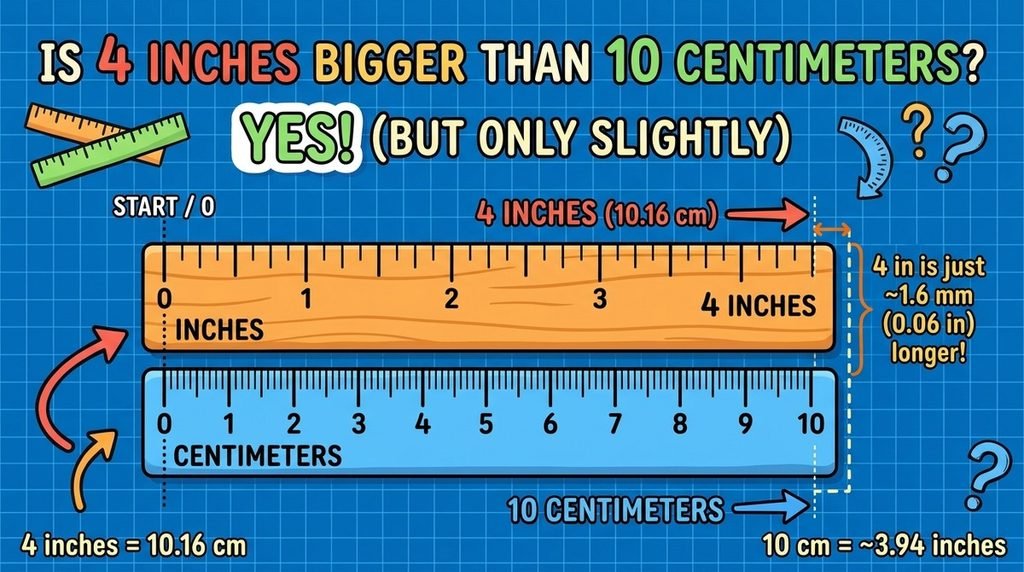
Yes. Four inches equals 10.16 centimeters, which is 0.16 centimeters longer than ten centimeters.
That difference is equal to 1.6 millimeters. It is small, so you might not notice it during a quick visual comparison.
For everyday estimates, you can think of four inches as approximately ten centimeters. When exact dimensions matter, use the full conversion of 10.16 centimeters.
Is 4 Inches One-Third of a Foot?
Yes. One foot contains twelve inches, and four inches is exactly one-third of twelve.
The calculation is:
4 ÷ 12 = 0.3333 feet, approximately.
This relationship is easy to remember when working with feet and inches. Four inches is one-third of a foot, eight inches is two-thirds, and twelve inches makes a complete foot.
Is 4 Inches Considered Small?
Whether four inches is small depends on the object you are measuring.
For a large appliance, four inches is a relatively small dimension. For a compact accessory, small container, or miniature decoration, it can represent a useful size.
The type of measurement matters, too. Four inches of height is different from four inches of width or diameter.
When comparing products, consider their intended use and complete dimensions instead of judging the number alone.
Frequently Asked Questions
How many centimeters are in 4 inches?
Four inches equals exactly 10.16 centimeters. Multiply four by 2.54 to convert inches into centimeters.
How many millimeters are in 4 inches?
Four inches equals 101.6 millimeters. This conversion is useful for measuring small components and product dimensions.
How many feet is 4 inches?
Four inches equals approximately 0.3333 feet, which is one-third of a foot.
What does 4 inches look like?
Four inches is slightly longer than ten centimeters. You can picture it using a ruler or compare it with an object whose dimensions you know.
What household objects are close to 4 inches?
Some small notebooks, compact kitchen tools, wallets, and miniature picture frames may have a dimension close to four inches. Their actual sizes vary, so check the specific item before using it as a reference.
Is 4 inches the same as 10 cm?
No. Four inches equals 10.16 centimeters, making it 0.16 centimeters longer than ten centimeters.
Can I measure 4 inches with my hand?
You can use your palm as a rough reference, but hand sizes differ. Measuring your palm once with a ruler will give you a more reliable personal estimate.
Is 4 inches half of 8 inches?
Yes. Four inches is exactly half of eight inches. Two four-inch lengths placed end to end make eight inches.
How many meters are in 4 inches?
Four inches equals 0.1016 meters, which is slightly more than one-tenth of a meter.
What is the easiest way to measure 4 inches accurately?
A ruler or measuring tape is the easiest reliable option. Align the starting point with zero and read the measurement at the four-inch mark.
Conclusion
Four inches equals 10.16 centimeters, 101.6 millimeters, and approximately one-third of a foot. Understanding this length can help you compare products, organize small spaces, and complete craft projects.
Everyday objects can help you visualize the distance, but their dimensions vary. Use a ruler or measuring tape whenever accuracy matters, and check whether a product’s measurement describes its length, width, height, or diameter.
For additional information about measurement, explore units.

Oliver Bennett is a dedicated writer passionate about measurements, dimensions, and practical size guides. Through InchesLines, he helps readers understand measurements, explore inch conversions, and find accurate dimensions for everyday needs.