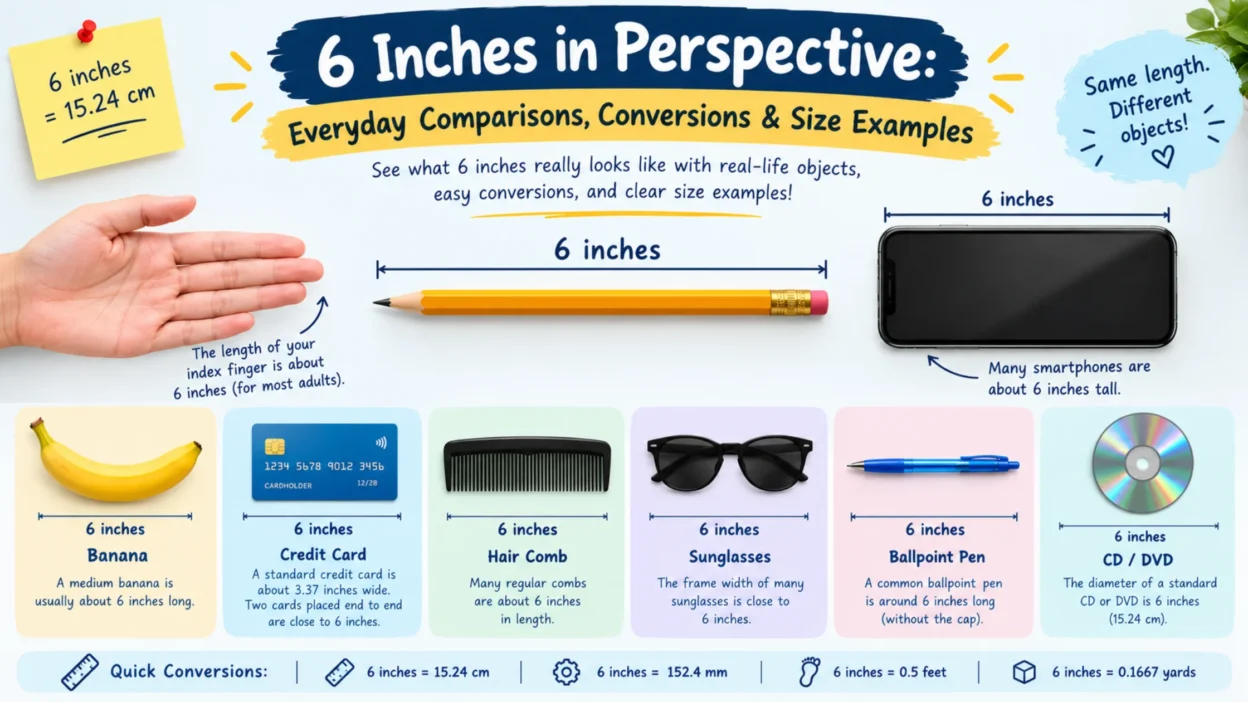
Six inches is a useful measurement for comparing small objects, stationery, and household items. However, visualizing this length without a ruler can sometimes be difficult.
This length equals 15.24 centimeters, 152.4 millimeters, or half a foot. Remembering these conversions makes it easier to estimate dimensions when shopping, crafting, or measuring everyday objects.
In this guide, you will learn how to visualize this length, convert it into different units, and compare it with familiar household items.
How Long Is Six Inches?
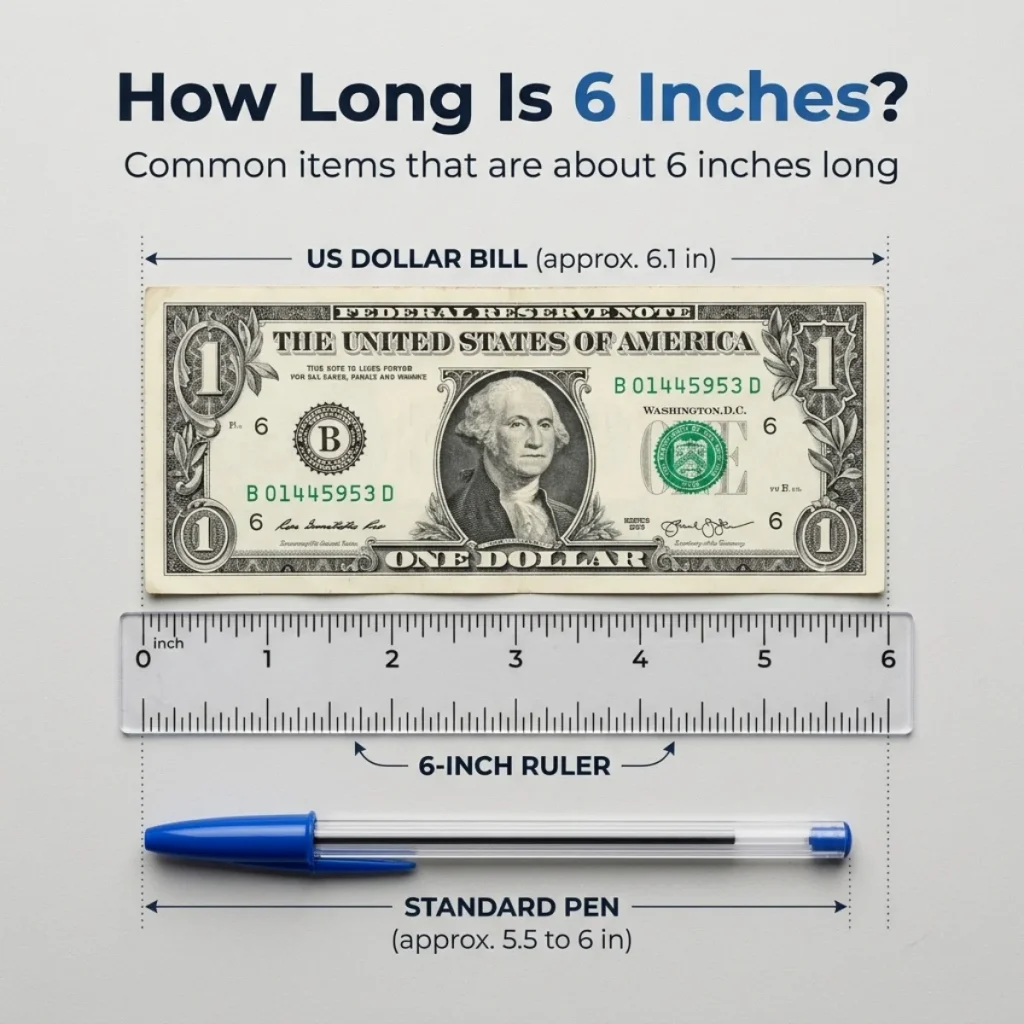
Six inches measures exactly 15.24 centimeters. It is also equal to 152.4 millimeters and 0.5 feet.
Imagine a standard 12-inch ruler. The distance from its starting point to the halfway mark represents this measurement.
This length can describe an object’s height, width, thickness, or overall length. Always check which dimension you need because an item’s height may differ considerably from its width.
Six-Inch Measurement Conversion Chart
Use this table to compare the same length across different measurement units.
| Measurement Unit | Equivalent to 6 Inches |
|---|---|
| Inches | 6 inches |
| Feet | 0.5 feet |
| Centimeters | 15.24 cm |
| Millimeters | 152.4 mm |
| Meters | 0.1524 m |
| Yards | 0.1667 yards |
These conversions are useful when checking product dimensions, following craft instructions, or comparing measurements from different countries.
How to Convert Inches Into Other Units
You can calculate the equivalent measurement using these simple formulas:
- Centimeters: Multiply 6 by 2.54 to get 15.24 cm.
- Millimeters: Multiply 6 by 25.4 to get 152.4 mm.
- Feet: Divide 6 by 12 to get 0.5 feet.
- Meters: Multiply 6 by 0.0254 to get 0.1524 meters.
- Yards: Divide 6 by 36 to get approximately 0.1667 yards.
The easiest conversion to remember is that one inch equals 2.54 centimeters. You can use this formula to convert many other measurements quickly.
Everyday Objects That Help Visualize This Length
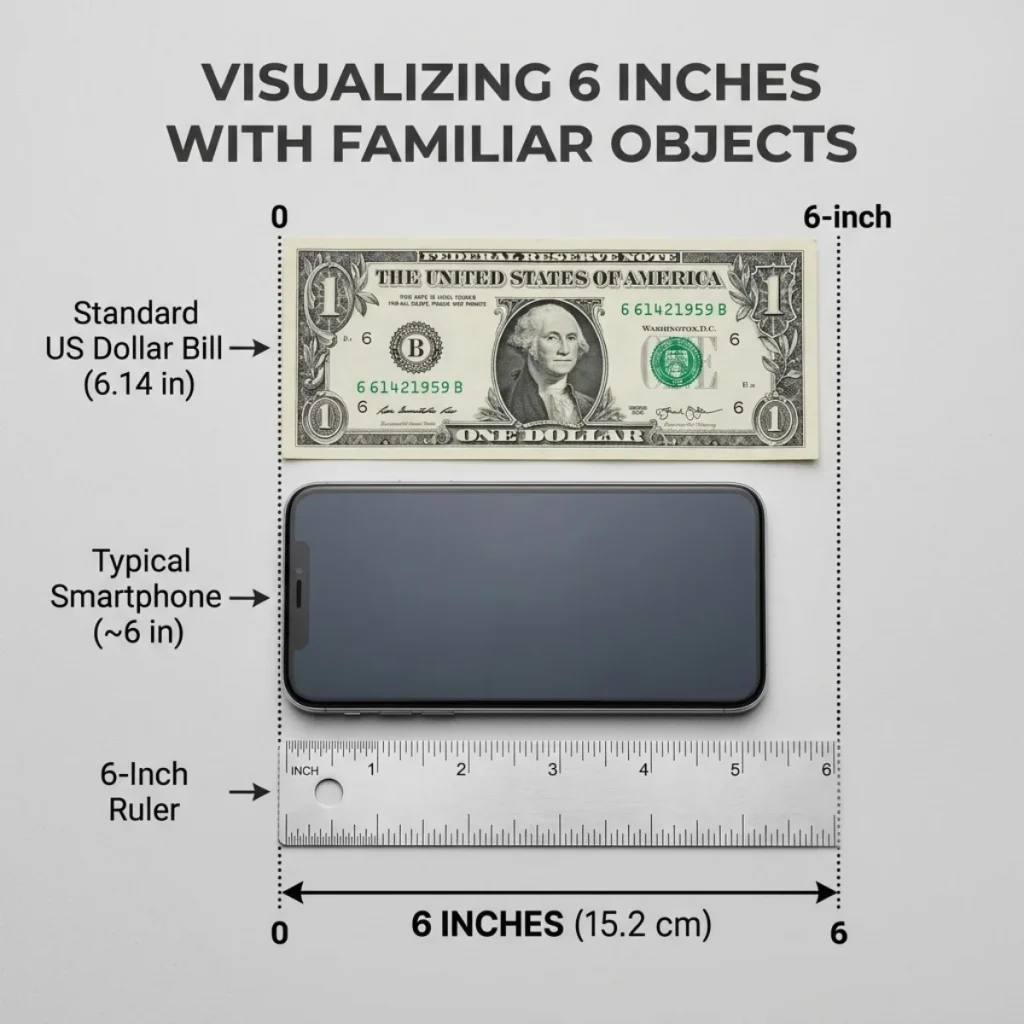
Familiar objects can help you estimate a measurement when a ruler is unavailable. A US dollar bill is particularly useful because its longer edge measures approximately 6.14 inches.
Other possibilities include compact pencils, toothbrushes, notebooks, and remote controls. However, their dimensions vary depending on the manufacturer and design.
Treat these examples as estimates rather than exact measurements. For accurate results, always check the individual object with a ruler or measuring tape.
10 Everyday Objects That Measure Around Six Inches
The following objects provide practical comparisons. Some are close to the target length, while others depend heavily on their design.
1. A US Dollar Bill
A US dollar bill measures approximately 6.14 inches long. This makes it a convenient reference when estimating a length close to 15.24 centimeters.
Its longer edge exceeds the target by just 0.14 inches. Although this difference is small, the bill is not an exact measuring tool.
If you have a dollar bill nearby, use its longer edge to visualize a similar length.
2. Half of a Standard Ruler
A standard 12-inch ruler provides a reliable reference for this measurement. Its halfway point represents exactly 6 inches.
Simply locate the six-inch mark and compare the distance from zero. This method is more dependable than estimating measurements with household objects.
A ruler is especially useful for school projects, crafts, and checking product dimensions.
3. A Small Pencil
Some compact pencils measure approximately six inches long. However, many full-size pencils are longer, and used pencils become shorter through sharpening.
Place your pencil beside a ruler to check its actual length. If it measures close to 15.24 centimeters, you can use it as a personal reference.
Always check the individual pencil instead of assuming every model has identical dimensions.
4. An Adult Toothbrush
Some adult toothbrushes are close to this length. Others are longer or shorter because manufacturers use different handle shapes and brush-head designs.
Measure from the end of the handle to the tip of the bristles. This gives you the toothbrush’s total length.
A compact toothbrush may provide a helpful comparison, but its dimensions should be verified before use.
5. A Small Notebook
Certain pocket notebooks measure approximately six inches along their longer edge. Their sizes vary according to the format and manufacturer.
Measure the notebook’s height rather than its thickness. This provides a more meaningful comparison with the intended length.
Small notebooks are useful references when estimating stationery dimensions or choosing accessories.
6. A TV Remote Control
Some compact television remotes measure close to this length. Larger models may be longer because they include additional buttons or features.
Place the remote on a flat surface and measure from one end to the other. Compare the result with 15.24 centimeters.
Remember that remote controls differ considerably, so this comparison is only an estimate.
7. A Dinner Fork
Some smaller dinner forks are approximately six inches long. However, many standard forks exceed this measurement.
Measure from the tips of the prongs to the opposite end of the handle. This gives you the utensil’s total length.
A fork offers a familiar household comparison, but its dimensions depend on the particular design.
8. A Small Hairbrush
Compact hairbrushes can provide another useful reference. Some travel-sized models measure close to six inches from end to end.
Full-size brushes are often larger, so check the dimensions before using one for comparison.
Measure the entire brush, including its handle and bristles. This helps you compare its total length with the target measurement.
9. A Small Kitchen Spatula
Some miniature spatulas are approximately six inches long. These compact utensils are often designed for small jars and other kitchen tasks.
Measure the complete utensil, including its handle and working end. This provides a consistent comparison with other objects.
Larger cooking spatulas may be considerably longer, so the result depends on the particular product.
10. A Compact Makeup Brush
Some makeup brushes measure close to six inches from the handle’s end to the bristle tips.
Travel-sized brushes may be shorter, while full-size models can exceed this length. Their dimensions depend on the product and intended use.
Lay the brush flat and measure its entire length. You can then determine whether it provides a useful reference.
How to Estimate Six Inches Without a Ruler
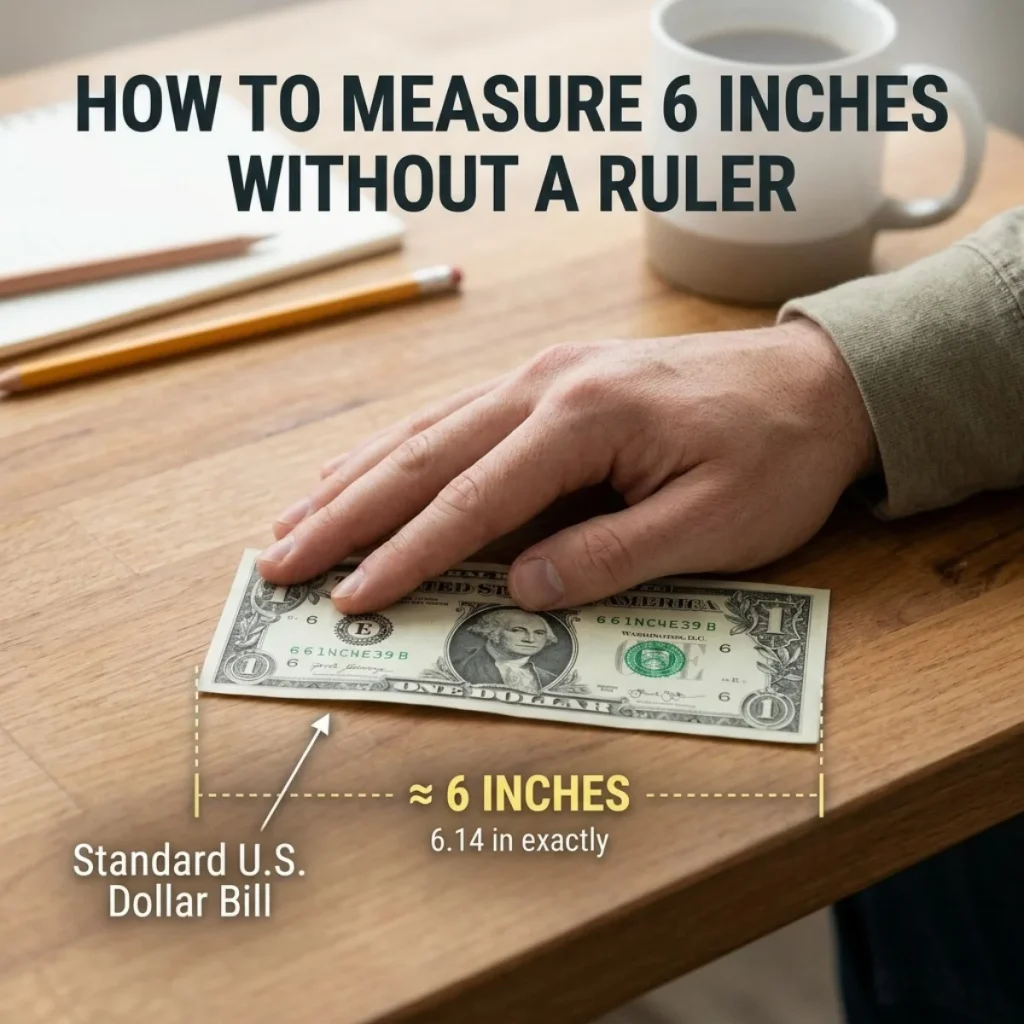
You can estimate small measurements using familiar objects or digital tools. However, these methods differ in accuracy.
Use a US Dollar Bill
A dollar bill measures approximately 6.14 inches along its longer edge. This makes it a convenient reference for estimating a similar length.
Remember that the bill is slightly longer than the target. Avoid relying on this method when precise measurements are necessary.
Use the Halfway Point of a 12-Inch Ruler
If you have a standard ruler, locate its six-inch mark. The distance from zero to this point represents exactly half a foot.
You do not need to bend or fold the ruler. Simply use the halfway mark to identify the required length.
Print a Measurement Guide
A printable ruler can help when you need a quick reference. Choose a guide with a clearly marked six-inch line.
Set your printer to 100% or Actual Size rather than Fit to Page. Printer scaling can change the dimensions of the printed line.
Check the result against a physical ruler before using it for accurate measurements.
Measure Your Hand
Your hand can provide a personal reference for estimating lengths. However, hand sizes vary, so there is no universal hand measurement that equals six inches.
Measure a particular distance across your hand using a ruler. You can then use that distance for rough estimates later.
This method is convenient for everyday comparisons but should not replace accurate measuring tools.
Try a Smartphone Measuring App
Some smartphones offer camera-based measurement tools. These apps can estimate the dimensions of objects without requiring a separate ruler.
Accuracy depends on the device, lighting, camera position, and object shape. Results may therefore differ from actual measurements.
Use a physical ruler or measuring tape whenever precision matters.
Frequently Asked Questions
How many centimeters equal six inches?
Six inches equals 15.24 centimeters. Multiply the inch measurement by 2.54 to convert it into centimeters.
Is six inches half a foot?
Yes. One foot contains 12 inches, making six inches exactly half a foot.
How many millimeters equal six inches?
Six inches equals 152.4 millimeters. Multiply the inch measurement by 25.4 to calculate the equivalent.
How many meters equal six inches?
The equivalent is 0.1524 meters. This is the same as 15.24 centimeters.
Is a US dollar bill exactly six inches long?
No. A US dollar bill measures approximately 6.14 inches long. It is slightly longer than the measurement discussed in this guide.
Which everyday object is closest to this length?
A US dollar bill is a convenient example because it measures approximately 6.14 inches. Other objects may also be close, but their dimensions vary.
What is the most accurate way to measure six inches?
Use a ruler or measuring tape with clearly marked inch measurements. Align the object’s starting point with zero and check the six-inch mark.
Is six inches considered a long measurement?
That depends on the object being measured. It is a useful length for handheld items but relatively short for furniture or larger household objects.
Final Thoughts
Understanding everyday measurements becomes easier when you connect numbers with familiar objects. A US dollar bill provides a convenient visual reference, while a standard ruler offers a more accurate comparison.
The metric equivalents are also simple to remember: 15.24 centimeters, 152.4 millimeters, and 0.1524 meters. These conversions help when checking product dimensions or following measurement instructions.
For precise results, always use a suitable measuring tool rather than relying entirely on estimates. You can also explore the history and principles of measurement to learn more about how people quantify length and other physical quantities.

Oliver Bennett is a dedicated writer passionate about measurements, dimensions, and practical size guides. Through InchesLines, he helps readers understand measurements, explore inch conversions, and find accurate dimensions for everyday needs.