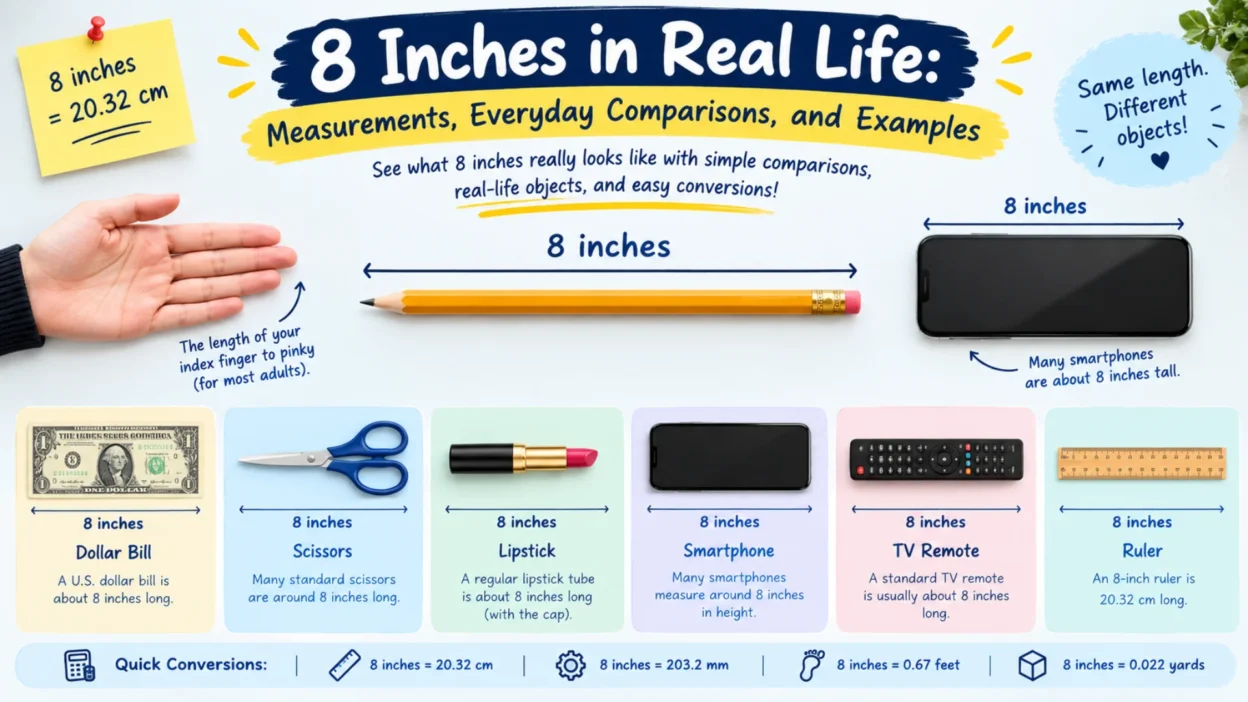
Eight inches is equal to 20.32 centimeters, 203.2 millimeters, or approximately 0.67 feet. It is a useful length to understand when measuring household items, choosing products online, or estimating the size of everyday objects.
Although eight inches may sound like a small distance, it can look quite different depending on what you are measuring. For example, it is a common screen size for some compact tablets, a possible diameter for a small plate, and a typical blade length for certain kitchen knives.
Understanding this measurement can help you picture product dimensions before buying something. It can also make it easier to compare measurements listed in inches, centimeters, and millimeters.
In this guide, you will learn how long 8 inches is, how to convert it into other units, which everyday objects are close to this size, and how to estimate the distance without a ruler.
How Long Is 8 Inches?
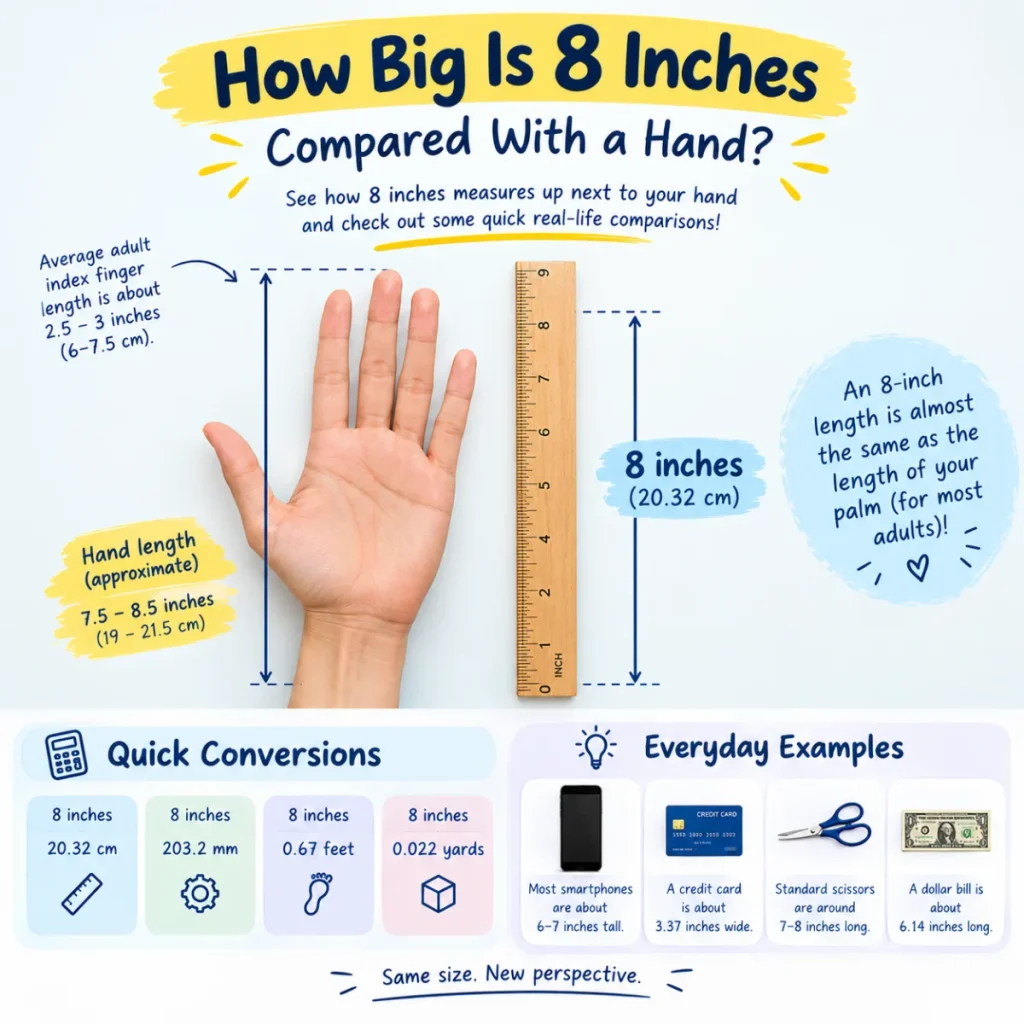
Eight inches measures exactly eight inches along a straight line. On a standard ruler, it is the distance from the zero mark to the mark labeled 8.
In metric units, 8 inches equals 20.32 centimeters. This means it is slightly longer than 20 centimeters. The difference is only 0.32 centimeters, or 3.2 millimeters.
To picture this length, imagine a straight line measuring just over 20 centimeters. It is longer than a typical adult hand’s width for many people, although hand sizes vary. It is also shorter than a standard 12-inch ruler.
Eight inches can describe the length, width, height, or diameter of an object. The exact meaning depends on how the object is measured. For example, an 8-inch tablet usually refers to the diagonal measurement of its screen, not the length of the entire device.
When shopping online, always check whether a measurement refers to the screen, the full product, the diameter, or another dimension. This small detail can make a big difference when deciding whether an item will fit your needs.
8 Inches to Centimeters, Millimeters, and Other Units
Converting inches into other units makes measurements easier to understand. This is particularly helpful when product descriptions use different measurement systems.
Here is a quick conversion chart for 8 inches.
| Measurement Unit | Equivalent |
|---|---|
| Inches | 8 inches |
| Centimeters | 20.32 cm |
| Millimeters | 203.2 mm |
| Feet | 0.6667 ft |
| Yards | 0.2222 yd |
| Meters | 0.2032 m |
| Kilometers | 0.0002032 km |
The most useful conversion is usually from inches to centimeters. Many products sold internationally display dimensions in both units, while some listings use inches only.
If you need a quick estimate, you can remember that 8 inches is a little more than 20 centimeters. However, if you are measuring furniture, a fitting, or a product that must fit into a specific space, use the exact value of 20.32 centimeters.
How to Convert 8 Inches to Centimeters
One inch equals exactly 2.54 centimeters. To convert inches into centimeters, multiply the number of inches by 2.54.
The calculation is:
8 × 2.54 = 20.32 centimeters.
Therefore, 8 inches equals 20.32 cm.
This formula works for any inch measurement. For example, 5 inches equals 12.7 centimeters, while 10 inches equals 25.4 centimeters.
How to Convert 8 Inches to Millimeters
One inch equals 25.4 millimeters. Multiply 8 by 25.4 to find the equivalent measurement.
8 × 25.4 = 203.2 millimeters.
Therefore, 8 inches equals 203.2 mm.
Millimeters are useful when measuring small parts, hardware, tools, and other items that require more detail. If a product is listed as 203.2 mm long, it has the same length as an 8-inch item.
How to Convert 8 Inches to Feet
One foot contains 12 inches. To convert 8 inches into feet, divide 8 by 12.
8 ÷ 12 = 0.6667 feet, approximately.
This means 8 inches is about two-thirds of a foot. It is also 4 inches shorter than one full foot.
How to Convert 8 Inches to Meters
One inch equals 0.0254 meters. Multiply 8 by this value.
8 × 0.0254 = 0.2032 meters.
Therefore, 8 inches equals 0.2032 meters. This is slightly more than one-fifth of a meter.
10 Everyday Objects That Can Help You Picture 8 Inches
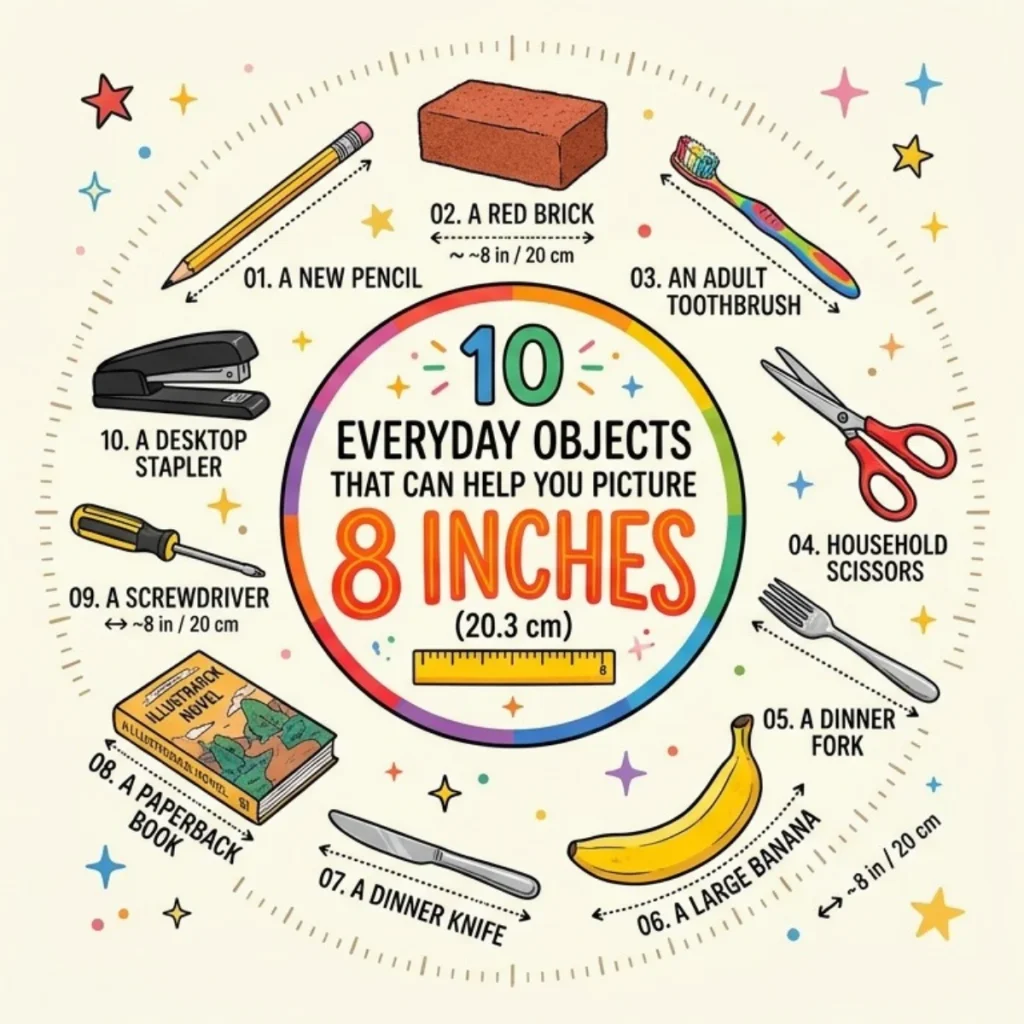
Everyday objects can help you estimate a measurement when you do not have a ruler nearby. However, the comparisons below are approximate because products come in different shapes and sizes.
For the most reliable comparison, check the dimensions of the specific object you plan to use.
1. A Compact Tablet Screen
Some compact tablets have screens marketed as approximately 8 inches. This makes them a useful example of how the measurement appears in everyday life.
However, an 8-inch screen does not mean the entire tablet is 8 inches long. Screen sizes are normally measured diagonally from one corner of the display to the opposite corner.
The device itself may be wider or longer depending on its aspect ratio and the size of its borders. If you are buying a tablet, check its complete height and width rather than relying only on the screen measurement.
2. A Small Dinner Plate
Some small dinner plates measure close to 8 inches in diameter. Diameter means the straight distance from one side of a circular plate to the opposite side, passing through the center.
An 8-inch plate can be useful for snacks, desserts, or smaller meals. However, many dinner plates are larger, and some side plates are smaller.
If you have a plate at home, measure straight across its widest point to compare it with 8 inches.
3. A Kitchen Knife Blade
Some chef’s knives have blades measuring around 8 inches. This is a common size for knives used to chop vegetables, slice meat, and prepare everyday meals.
When comparing a knife with an 8-inch measurement, remember that blade length is not the same as total knife length. The handle adds extra length.
A knife with an 8-inch blade may be considerably longer than 8 inches from the handle’s end to the tip. Always check which measurement the manufacturer provides.
4. A Paperback Book
Certain paperback books are close to 8 inches tall. This can provide a simple visual reference because books have straight edges and are easy to compare with other objects.
However, book sizes vary according to the publisher, format, and subject. A pocket-sized paperback may be much shorter, while a larger paperback can exceed 8 inches.
If you want to use a book as a reference, measure its height first. Once you know its dimensions, you can use it for rough comparisons.
5. A Large Smartphone
Eight inches is longer than the overall length of many smartphones. A large smartphone can still help you picture the distance, especially if you know the exact dimensions of your device.
For example, you could compare an 8-inch line with the length of your phone and notice how much longer the line is.
Avoid assuming that every smartphone has the same size. Screen size, body length, and body width are different measurements, so check the manufacturer’s specifications when accuracy matters.
6. A Small Kitchen Spatula
Some small kitchen spatulas measure around 8 inches from one end to the other. They are useful household references because their overall length is easy to see.
Other spatulas are much longer, particularly those designed for cooking in deep pots or large pans. The handle and head shape also affect the total length.
If your spatula is close to 8 inches, you can use it for a quick estimate. For a precise measurement, use a measuring tape or ruler.
7. A Short Section of a Standard Ruler
A standard 12-inch ruler provides one of the easiest ways to understand 8 inches. Simply look at the distance between the zero mark and the 8-inch mark.
This comparison is more reliable than using an object with an unknown size. It also helps you understand that 8 inches is two-thirds of a 12-inch ruler.
If you have a ruler that shows both inches and centimeters, you can see that the 8-inch mark corresponds to 20.32 centimeters.
8. A Small Serving Tray
Some small serving trays have a width or length close to 8 inches. Their flat surfaces make it easier to compare the measurement with a straight line.
However, serving trays come in many shapes and sizes. A tray may be 8 inches wide but much longer in the other direction.
Always identify which dimension you are comparing. Width, length, and depth describe different parts of an object.
9. A Piece of Paper
A piece of paper can help you estimate 8 inches if you know its actual dimensions. For example, standard US letter paper measures 8.5 inches wide and 11 inches long.
An 8-inch distance is therefore half an inch shorter than the width of letter paper. This is a particularly useful comparison when you have paper but no ruler.
Paper sizes differ around the world, so do not assume every sheet has the same width. If you need a close estimate, identify the paper size first.
10. A Small Household Container
Some small containers, storage boxes, and kitchen organizers have one dimension close to 8 inches. This can help you picture the measurement when arranging items around your home.
However, containers vary considerably in height, width, and depth. A box might be 8 inches tall but only 5 inches wide.
When checking whether a container will fit on a shelf, measure the exact side that matters. Also leave enough space for handles, lids, or other parts that extend beyond the main body.
How Big Is 8 Inches Compared With a Hand?
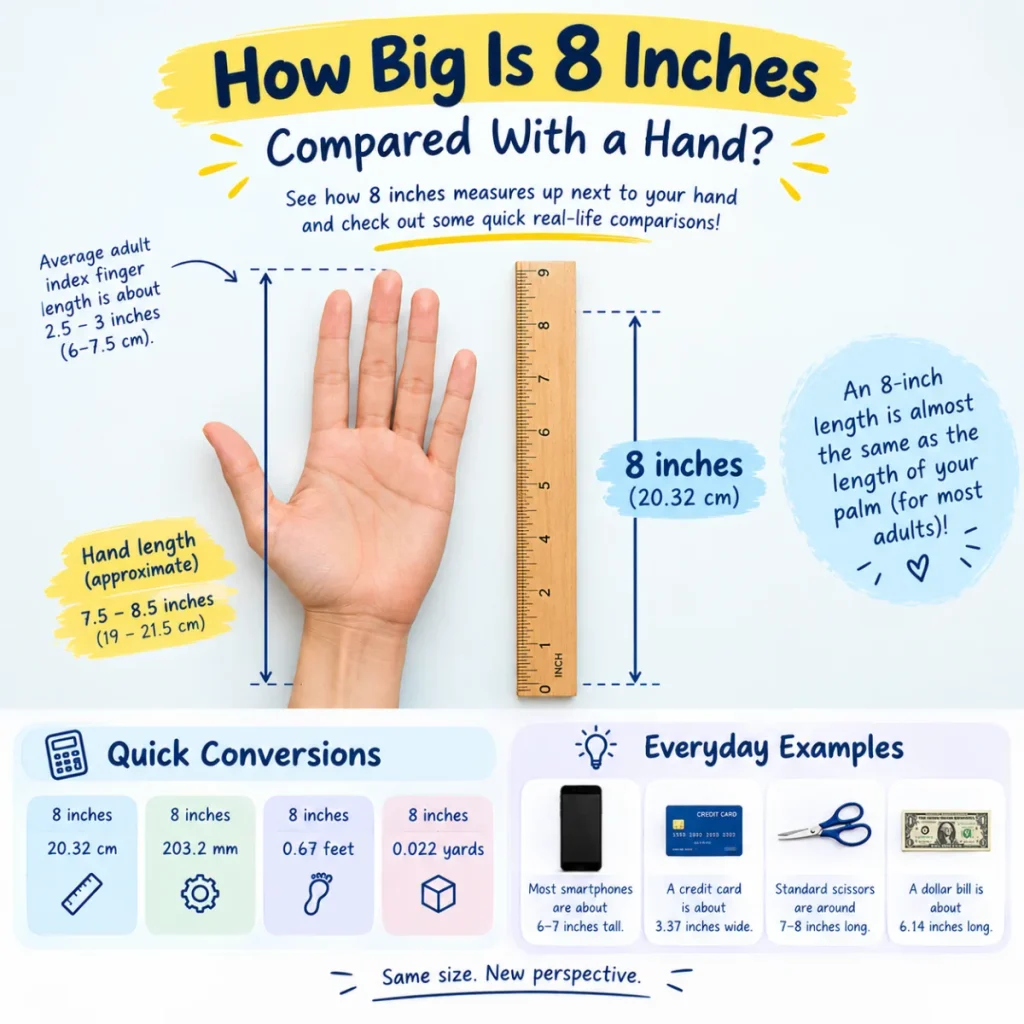
Many people use their hands to estimate measurements when a ruler is unavailable. This can be convenient, but it is important to remember that hand sizes differ from person to person.
For some adults, the width of an open hand is close to 8 inches. For others, it may be noticeably smaller. Hand width also changes depending on whether you measure across the palm or include the thumb.
Finger length is another unreliable reference. The length of an index finger or thumb differs with age, body size, and individual proportions.
If you want to use your hand as a measuring guide, measure it once with a ruler. You can then remember your own approximate hand width for future estimates.
For example, if your open hand measures 7 inches across, an 8-inch distance will be about 1 inch longer than your hand width. This approach is more useful than assuming everyone’s hands measure the same.
Hand-based estimates are suitable for rough everyday comparisons. They are not ideal for cutting materials, choosing fitted products, or completing work where a small measurement error could cause problems.
How to Measure 8 Inches Without a Ruler
You can estimate 8 inches even if you do not have a ruler or measuring tape. The best method depends on the objects available and how accurate the result needs to be.
Method 1: Use a Sheet of Letter Paper
If you have standard US letter paper, its width is 8.5 inches. An 8-inch distance is half an inch shorter than that width.
This gives you a useful reference for estimating the length. However, it works only if the paper is actually the standard letter size.
If you use A4 paper, its width is approximately 8.27 inches. That is also close to 8 inches, but it is not exactly the same.
Method 2: Use Your Smartphone
Your smartphone may be useful as a reference if you know its exact height or width. Check the manufacturer’s specifications to find the dimensions of the device.
Place the phone beside the distance you want to estimate and compare the lengths visually. If your phone is 6.2 inches tall, for example, an 8-inch distance would be 1.8 inches longer.
Do not assume that the screen’s diagonal size equals the phone’s height. A phone with a 6.2-inch screen usually has a different body length because the screen is measured diagonally.
Method 3: Use a Known-Length Object
An object with known dimensions can help you estimate 8 inches. A book, plate, or small tool may work if you know its exact size.
Compare the object with the distance you want to measure. If the reference object is 4 inches long, two lengths of that object would equal 8 inches.
This method works best with straight objects that can be placed end to end. Avoid leaving gaps or overlapping the objects because that will affect the estimate.
Method 4: Use a Measurement App
Some smartphones include a measurement app that uses the camera to estimate the size of objects. Depending on the device, the app may use augmented reality or other sensors.
Open the app and follow its instructions to mark the starting and ending points. The result can be helpful for rough measurements around the house.
However, camera-based measurements may be affected by lighting, distance, camera angle, and the surface being measured. Do not rely on them for tasks that require high precision unless you have verified the result.
Method 5: Mark the Distance on Paper
If you have access to a ruler later, you can make a mark on paper and check it afterward. This is useful when you need to compare an object with a measurement but do not have a measuring tool immediately available.
Place the object against the paper and mark its starting and ending points. Once you have a ruler, measure the marked distance.
If you are estimating 8 inches without any known reference, this method cannot guarantee accuracy on its own. It is more useful when combined with a known-size object or a measurement app.
Common Uses for an 8-Inch Measurement
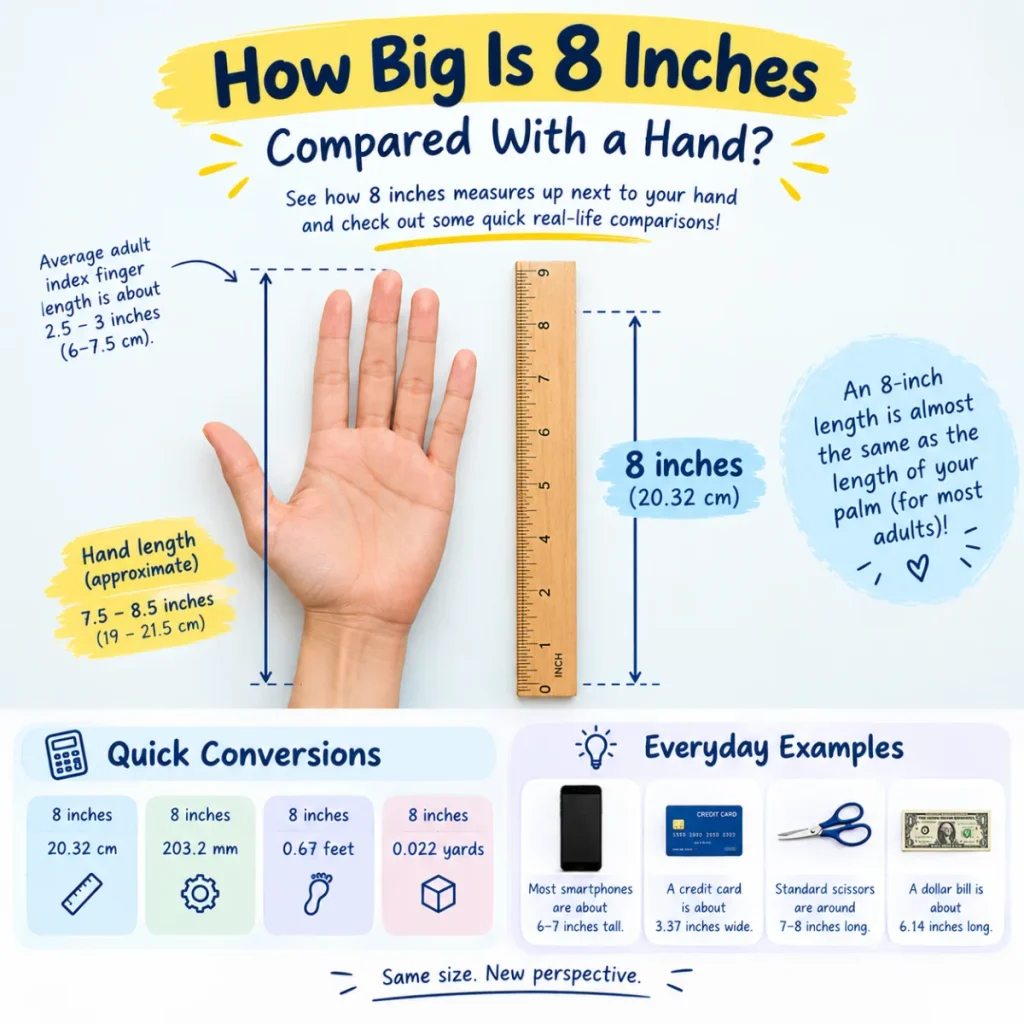
Eight inches appears in many everyday situations. Knowing its approximate size can help you make better decisions when buying products or organizing your home.
Shopping for Electronics
Some compact tablets have screens around 8 inches diagonally. This size can offer a balance between portability and screen space.
However, two tablets with the same screen size may have different overall dimensions. Their aspect ratios, borders, and body designs can affect how large they feel in your hands.
Before purchasing a tablet, check its screen size, full height, full width, and thickness. These measurements will help you determine whether it fits in your bag or can be held comfortably.
Choosing Kitchen Tools
Kitchen knives, spatulas, and other utensils may include measurements close to 8 inches. For knives, check whether the listed length refers to the blade or the complete product.
The right size depends on the task. A longer blade may be suitable for certain cutting jobs, while a shorter utensil may be easier to control in a small kitchen.
Always follow safe handling instructions when using sharp tools, and avoid choosing a utensil based on length alone.
Arranging Household Items
An 8-inch measurement can help you decide whether a small item will fit on a shelf, in a drawer, or inside a storage box.
For example, if a space is 8 inches wide, an item that measures exactly 8 inches may fit tightly. The actual fit can depend on how the object is shaped and whether the measurements include handles or other extensions.
For a better fit, measure the available space and the product. Leave a little extra room if you need to slide the item in and out easily.
Buying Plates and Serving Items
Plate diameter is often given in inches. Understanding the difference between 8-inch and larger plates can help you choose suitable items for snacks, desserts, or smaller portions.
Remember that diameter measures straight across a circle through its center. It is not the same as the circumference, which measures around the outside edge.
If a product listing gives both measurements, use diameter when checking how much table or cupboard space the plate needs.
Measuring Craft and DIY Materials
Eight inches can be useful when cutting paper, fabric, or other materials for a project. Accurate measurements help pieces fit together as intended.
For these tasks, use a ruler or measuring tape rather than relying on visual comparisons. A small error can become more noticeable when several pieces need to match.
If you are working with a material that stretches, bends, or has uneven edges, measure it carefully on a flat surface before cutting.
Is 8 Inches Bigger Than 20 Centimeters?
Yes. Eight inches equals 20.32 centimeters, so it is 0.32 centimeters longer than 20 centimeters.
That difference is equal to 3.2 millimeters. It is small enough to be difficult to notice during a casual visual comparison, but it can matter in precise work.
For a quick estimate, you can think of 8 inches as a little more than 20 centimeters. When exact dimensions matter, use the full conversion of 20.32 centimeters.
Is 8 Inches Two-Thirds of a Foot?
Yes. One foot contains 12 inches, and 8 divided by 12 equals two-thirds.
This means 8 inches is approximately 0.67 feet. It is also 4 inches shorter than a full foot.
A simple way to remember the relationship is that half a foot is 6 inches, while two-thirds of a foot is 8 inches.
Is 8 Inches Considered a Large Size?
Whether 8 inches is large depends on the object and its purpose.
For a smartphone, 8 inches would be unusually long for the body of many models. For a compact tablet screen, it is a common diagonal size. For a dinner plate, it may be considered small compared with many full-size dinner plates.
For a kitchen knife, an 8-inch blade is a common size in some designs. For a bookshelf, however, 8 inches may be a relatively small depth.
The best way to judge a measurement is to compare it with the typical dimensions of similar products. Also check whether the measurement describes length, height, width, diameter, or screen size.
Frequently Asked Questions
How many centimeters are in 8 inches?
Eight inches equals exactly 20.32 centimeters. To calculate this, multiply 8 by 2.54 because one inch equals 2.54 centimeters.
How many millimeters are in 8 inches?
Eight inches equals 203.2 millimeters. This conversion is useful for small parts, tools, and product specifications that use metric measurements.
How many feet is 8 inches?
Eight inches equals approximately 0.6667 feet, or two-thirds of a foot. A full foot contains 12 inches.
Is 8 inches the same as 20 cm?
No. Eight inches equals 20.32 centimeters, which is 0.32 centimeters longer than 20 centimeters.
What household object is 8 inches long?
Some kitchen knife blades, compact utensils, books, and small household items may measure around 8 inches. Their exact dimensions vary, so check the specific item before using it as a reference.
Is an 8-inch tablet actually 8 inches long?
Not necessarily. Tablet screen sizes are generally measured diagonally across the display. The full device may be longer or wider depending on its design.
How can I measure 8 inches with my hand?
You can use your hand for a rough estimate, but hand sizes differ. Measure your hand once with a ruler if you want to use it as a personal reference.
Is 8 inches longer than a standard sheet of paper?
It depends on the paper size and which dimension you compare. Standard US letter paper is 8.5 inches wide and 11 inches long, so 8 inches is half an inch shorter than its width.
How much is 8 inches in meters?
Eight inches equals 0.2032 meters. This is slightly more than one-fifth of a meter.
Is 8 inches a good size for a small plate?
An 8-inch plate can be suitable for snacks, desserts, or smaller meals. Whether it is the right size depends on how you intend to use it and the size of the portions you serve.
Conclusion
Eight inches is equal to 20.32 centimeters, 203.2 millimeters, and approximately two-thirds of a foot. It is a useful measurement to recognize when comparing product sizes, organizing household items, or working on small projects.
Everyday objects such as compact tablet screens, small plates, paperback books, and kitchen tools can help you picture this length. However, these comparisons are only estimates because object dimensions vary by model and design.
When accuracy matters, use a ruler or measuring tape and check whether the measurement refers to an item’s length, width, height, diameter, or screen diagonal. Understanding these differences can help you avoid mistakes when shopping or measuring at home.
To learn more about how measurements are defined and used, explore the science and practice of measuring physical quantities.

Oliver Bennett is a dedicated writer passionate about measurements, dimensions, and practical size guides. Through InchesLines, he helps readers understand measurements, explore inch conversions, and find accurate dimensions for everyday needs.