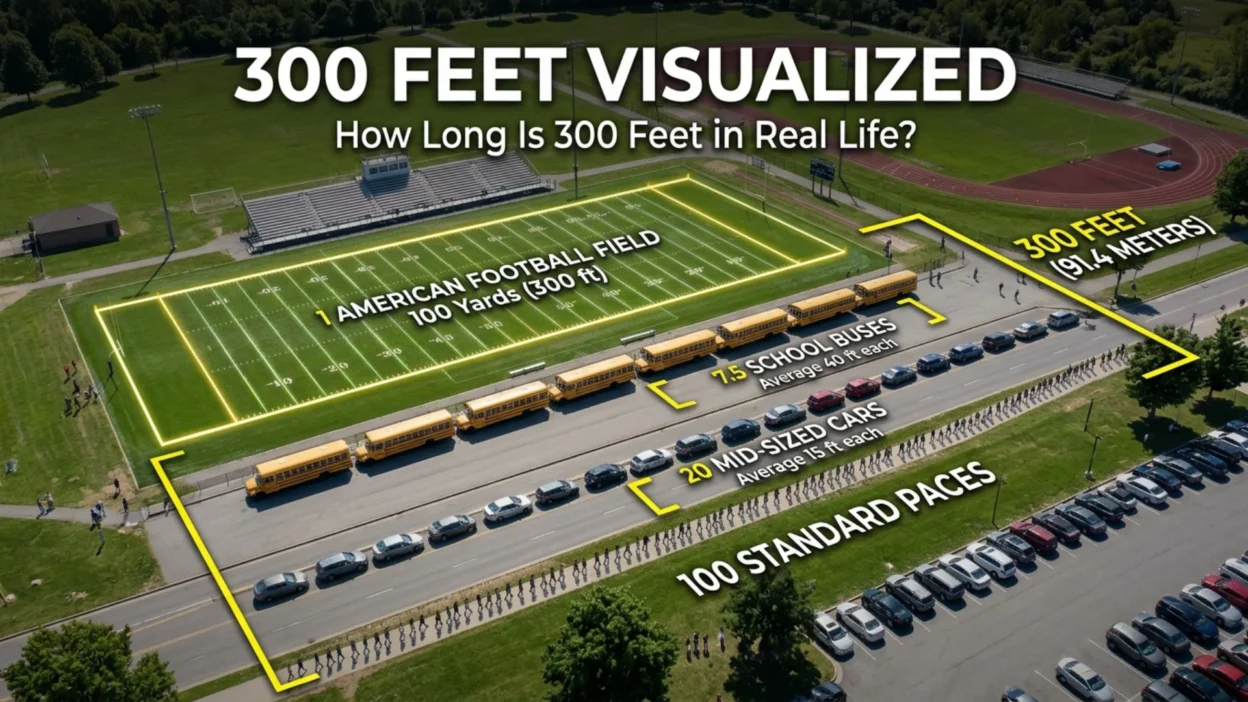
Three hundred feet is a surprisingly long distance. It is difficult to picture because most everyday objects are much smaller. However, comparing it with a football field, a large building, or an aircraft makes the measurement easier to understand.
300 feet equals 100 yards, 3,600 inches, or 91.44 meters. It is also approximately the length of an American football field between its two goal lines.
Whether you are estimating a building’s height, planning a property, or simply curious about large distances, these real-life comparisons will help you visualize 300 feet.
First, Understand the Size of 300 Feet
Before comparing this distance with familiar places, it helps to understand its basic measurements.
| Measurement Unit | Equivalent |
|---|---|
| Feet | 300 ft |
| Yards | 100 yd |
| Inches | 3,600 in |
| Meters | 91.44 m |
| Centimeters | 9,144 cm |
| Kilometers | 0.09144 km |
| Miles | 0.0568 miles |
One easy way to remember this distance is that 300 feet contains exactly 100 yards.
For smaller measurements, you can explore our guides to 12 inches and 8 inches. They show how smaller units fit into everyday measurements.
6 Real-Life Comparisons That Make 300 Feet Easier to Imagine
Numbers alone do not always communicate the size of a large distance. These familiar examples provide a better visual reference.
1. An American Football Field Between the Goal Lines
An American football field measures 100 yards between its two goal lines. Since one yard equals three feet, that distance is exactly 300 feet.
This makes a football field one of the easiest ways to visualize the measurement.
However, remember that the complete field is longer. It includes two 10-yard end zones, making its total length 120 yards, or 360 feet.
So, imagine standing at one goal line and looking toward the opposite goal line. That entire playing area represents 300 feet.
2. Almost Two Olympic Swimming Pools
An Olympic swimming pool is 50 meters long. That equals approximately 164 feet.
Two Olympic pools placed end to end would measure around 328 feet.
Therefore, 300 feet is slightly shorter than the combined length of two Olympic swimming pools.
This comparison is useful because swimming pool dimensions follow standardized specifications. It also helps you understand how much space this distance covers.
3. Around Two Large Passenger Aircraft
Large passenger aircraft can be surprisingly long. For example, a Boeing 777-300ER measures approximately 242 feet from nose to tail.
Two aircraft of this size would measure roughly 484 feet if placed end to end.
Therefore, 300 feet is longer than one aircraft but considerably shorter than two.
Picture one large passenger aircraft and imagine adding another 58 feet to its length. That gives you a rough idea of the distance.
4. Close to the Height of the Statue of Liberty
The Statue of Liberty measures approximately 305 feet from the ground to the top of its torch, including its pedestal and foundation.
That means 300 feet is only about five feet shorter than its complete height.
This is a useful comparison because the monument is a recognizable example of a structure that reaches roughly 300 feet.
Remember that the statue itself, without its pedestal, is much shorter.
5. About 30 Average-Height Adults Standing Together
For an easy human-height comparison, imagine 30 adults standing vertically, one above another.
If each person is approximately 5 feet tall, their combined height would be 150 feet.
You would need around 60 such adults stacked together to reach 300 feet.
This is only a mathematical illustration, not a practical way to measure the distance. It shows how large 300 feet is compared with an individual person.
6. A Very Long City Block
City blocks do not have one standard size. Their lengths depend on the city, street layout, and local planning.
However, a block measuring 300 feet from one end to the other would provide a useful example of this distance.
Imagine walking along a straight street for 300 feet. You would cover the same distance as the playing area between the goal lines of an American football field.
How Far Is 300 Feet Compared With Other Distances?
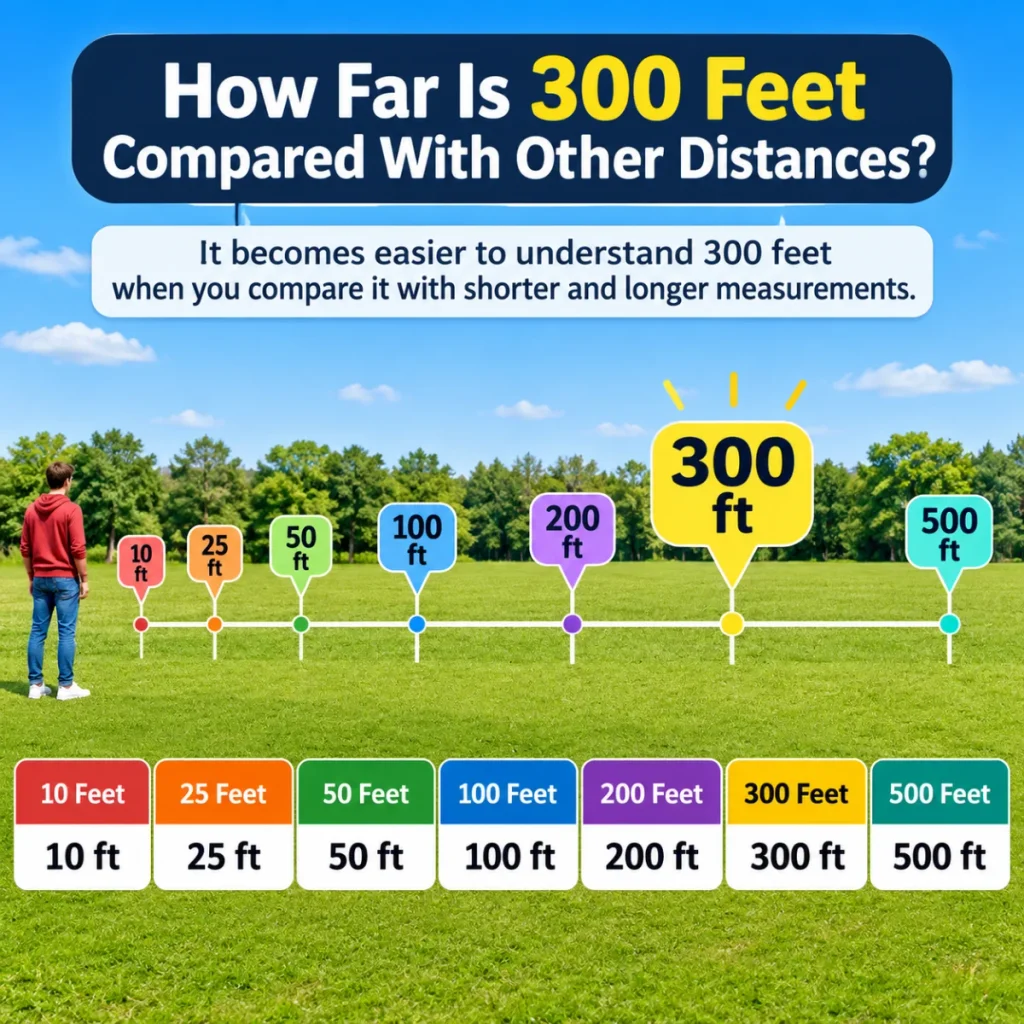
It becomes easier to understand 300 feet when you compare it with shorter and longer measurements.
| Distance | Equivalent in Feet |
|---|---|
| 10 feet | 10 ft |
| 25 feet | 25 ft |
| 50 feet | 50 ft |
| 100 feet | 100 ft |
| 200 feet | 200 ft |
| 300 feet | 300 ft |
| 500 feet | 500 ft |
For another perspective, 300 feet is three times the length of a 100-foot distance and 100 feet longer than 200 feet.
You can also compare smaller measurements using our guides to how long 7 inches is and how long 8 inches is.
These shorter examples show how quickly measurements add up when you move from inches to feet.
How Long Would It Take to Walk 300 Feet?
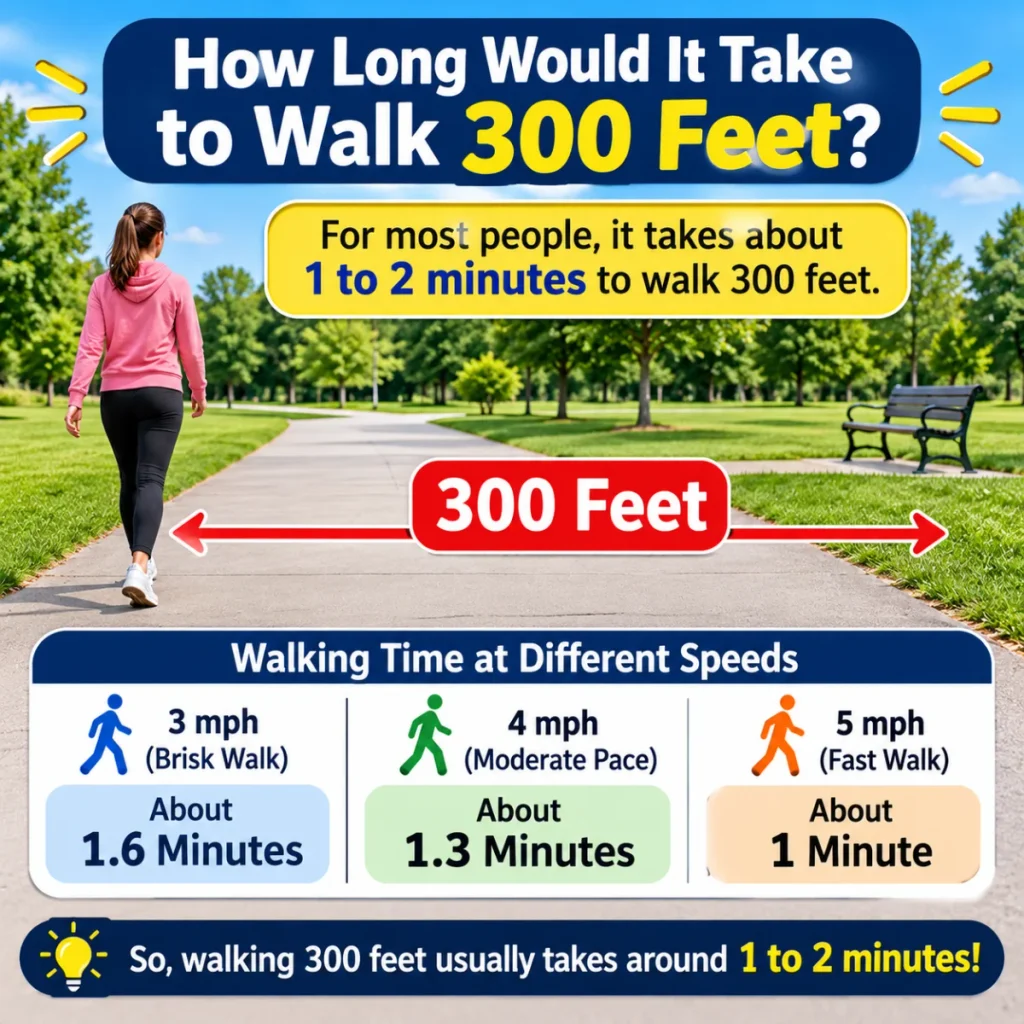
Walking time depends on your speed, walking surface, and surroundings.
At a moderate walking speed of approximately 3 miles per hour, covering 300 feet would take around 68 seconds.
Here are some approximate walking times:
| Walking Speed | Approximate Time |
|---|---|
| Slow walk | 1 minute 30 seconds |
| Moderate walk | 1 minute 8 seconds |
| Brisk walk | 55 seconds |
These figures are estimates rather than fixed times. A person walking on a clear, flat path may cover the distance faster than someone moving through a crowded area.
How Can You Measure 300 Feet Without Measuring the Entire Distance?
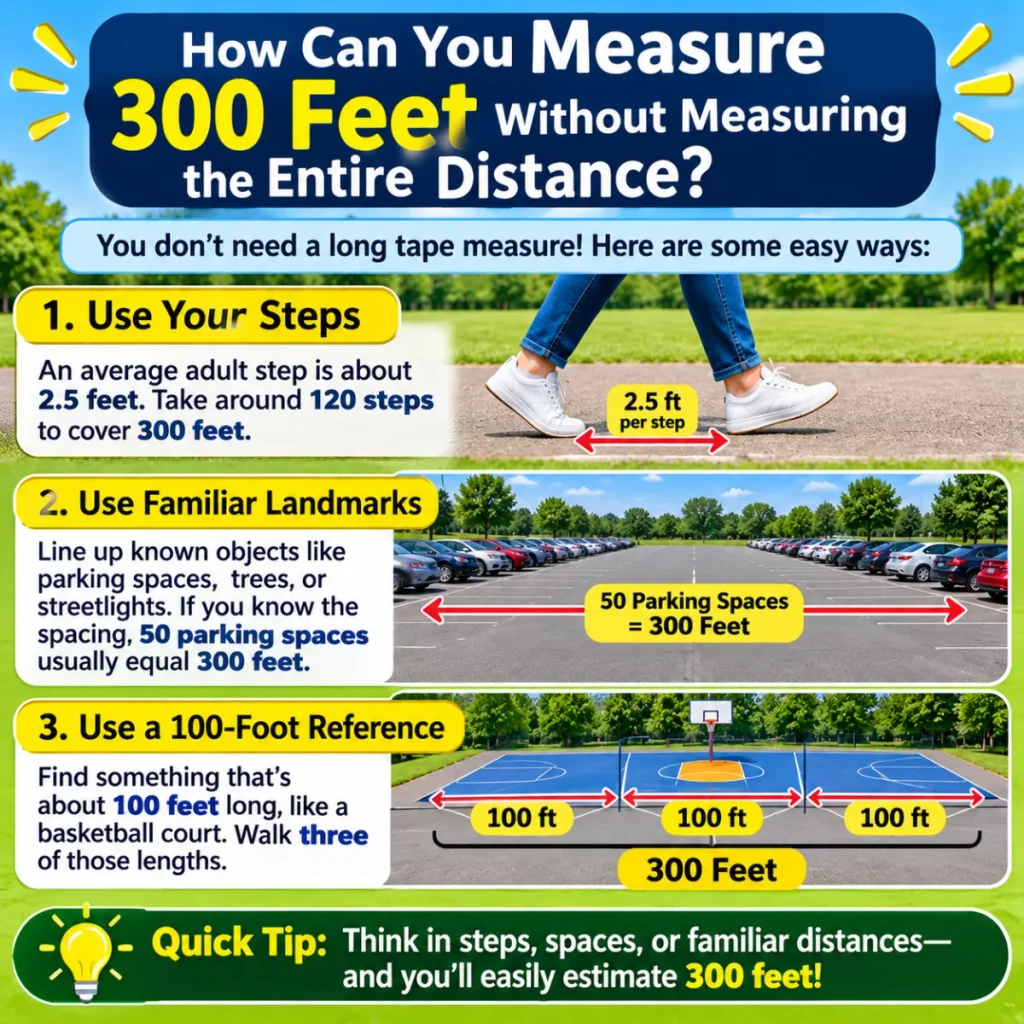
Measuring 300 feet can be challenging if you do not have a long measuring tape. However, you can estimate it using smaller distances.
Method 1: Use a 100-foot measuring tape
Measure 100 feet three times. Together, the three sections equal 300 feet.
Method 2: Count your walking steps
An average adult step may cover approximately 2.5 feet. At that step length, around 120 steps would cover 300 feet.
Actual step lengths vary, so this method provides an estimate only.
Method 3: Use a football field
If you have access to an American football field, the distance between the goal lines is exactly 300 feet.
Method 4: Use a digital measuring tool
Some mapping and measuring applications allow you to estimate distances between two points. These tools can be useful for property planning and outdoor measurements.
For smaller measurements, our guides to 6 inches and 4 inches provide additional examples of how different units relate to one another.
Where Is a 300-Foot Distance Useful?
Understanding this distance can help in several practical situations.
- Construction: Estimating the length of a large building or outdoor structure.
- Property planning: Understanding the distance between two points on a plot.
- Sports: Visualizing the playing area of an American football field.
- Aviation: Comparing the lengths of large passenger aircraft.
- Outdoor planning: Estimating walking distances across open spaces.
Always check the actual site dimensions when accuracy matters. A visual comparison is useful for understanding size, but it should not replace proper surveying or measurement equipment.
Frequently Asked Questions
How many yards are in 300 feet?
There are exactly 100 yards in 300 feet. Divide 300 by three to convert feet into yards.
Is 300 feet longer than a football field?
It depends on which part of the field you mean. The distance between the goal lines is exactly 300 feet. However, an American football field measures 360 feet when both end zones are included.
How many meters is 300 feet?
300 feet equals 91.44 meters. Multiply the number of feet by 0.3048 to convert it into meters.
How many inches are in 300 feet?
There are 3,600 inches in 300 feet. Each foot contains 12 inches, so 300 multiplied by 12 equals 3,600.
Is 300 feet close to the height of the Statue of Liberty?
Yes. The Statue of Liberty reaches approximately 305 feet from the ground to the top of its torch, including its pedestal and foundation.
How long does it take to walk 300 feet?
At a moderate walking speed, it takes approximately one minute and eight seconds. The actual time depends on your walking pace and surroundings.
Is 300 feet the same as 100 yards?
Yes. One yard contains three feet, so 100 yards equals exactly 300 feet.
Conclusion
Three hundred feet is a substantial distance, equal to 100 yards or 91.44 meters. The easiest way to picture it is to imagine the playing area between the goal lines of an American football field. Other comparisons, such as two Olympic swimming pools or the height of the Statue of Liberty, provide additional visual references.
Understanding distance and its different units makes it easier to estimate large spaces, compare structures, and interpret measurements in everyday life.

Oliver Bennett is a dedicated writer passionate about measurements, dimensions, and practical size guides. Through InchesLines, he helps readers understand measurements, explore inch conversions, and find accurate dimensions for everyday needs.