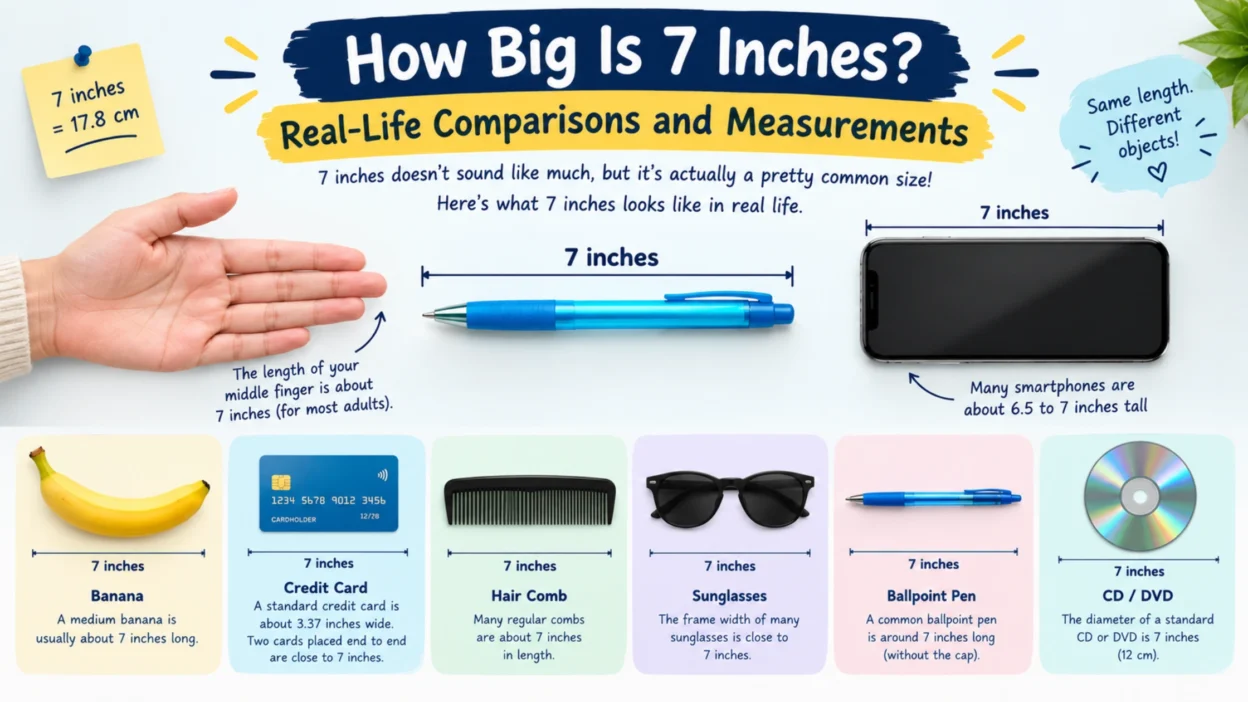
Seven inches might sound like a simple measurement, but it can be difficult to picture if you don’t have a ruler nearby. Whether you’re checking a product’s size, comparing everyday objects, or trying to understand a measurement in centimeters, knowing what 7 inches looks like can be helpful.
Seven inches is slightly longer than half a foot and equals 17.78 centimeters. This length is common enough to use when comparing small household items, accessories, stationery, and other everyday objects.
In this guide, you’ll learn how big 7 inches is, how to convert it into different measurement units, and which familiar objects can help you visualize this length.
How Long Is 7 Inches?
Seven inches measures exactly 17.78 centimeters, making it a little less than 18 cm. It is also equal to 177.8 millimeters and approximately 0.58 feet.
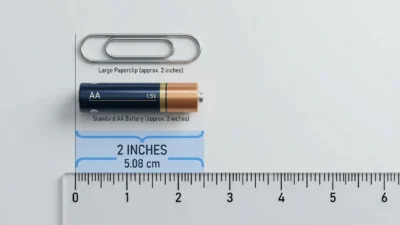
One easy way to understand this measurement is to compare it with a standard 12-inch ruler. Seven inches covers a little more than half the ruler’s total length.
The measurement can describe an object’s height, width, depth, or length. However, the direction matters. For example, a book measuring 7 inches tall may have a different width, while a screen described as 7 inches is generally measured diagonally.
7 Inches Conversion Chart
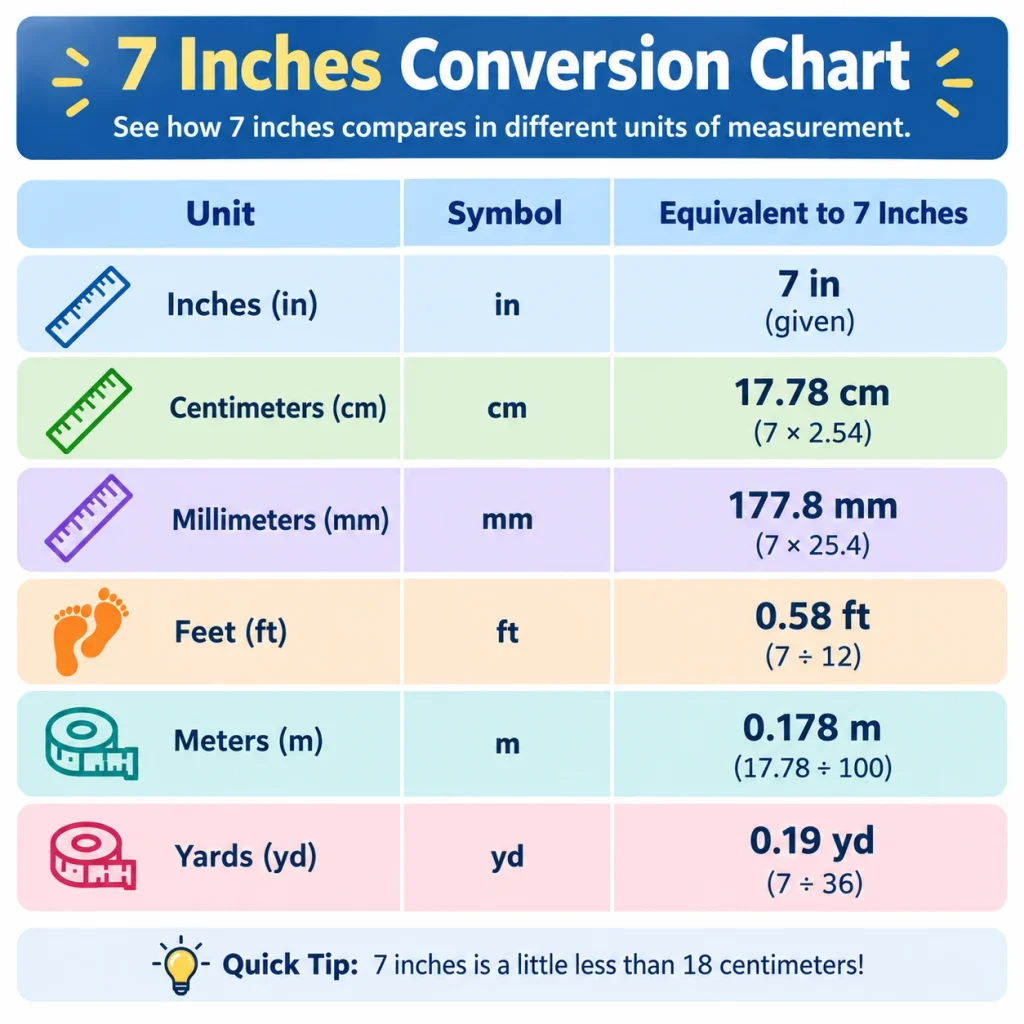
The following table shows how 7 inches converts into several common units of measurement.
| Measurement Unit | Equivalent to 7 Inches |
|---|---|
| Inches | 7 inches |
| Feet | 0.5833 feet |
| Centimeters | 17.78 cm |
| Millimeters | 177.8 mm |
| Meters | 0.1778 m |
| Yards | 0.1944 yards |
These conversions are useful when reading product specifications, following craft instructions, shopping online, or comparing measurements from countries that use different systems.
How to Convert 7 Inches
Converting 7 inches into other units is straightforward when you know the correct conversion factors.
- Inches to centimeters: Multiply 7 by 2.54 to get 17.78 cm.
- Inches to millimeters: Multiply 7 by 25.4 to get 177.8 mm.
- Inches to feet: Divide 7 by 12 to get approximately 0.5833 feet.
- Inches to meters: Multiply 7 by 0.0254 to get 0.1778 meters.
- Inches to yards: Divide 7 by 36 to get approximately 0.1944 yards.
For quick calculations, remember that one inch always equals 2.54 centimeters. This makes converting other inch measurements easier, too.
What Does 7 Inches Look Like?
The easiest way to visualize 7 inches is to compare it with something familiar. A 7-inch vinyl record has a nominal diameter of 7 inches, while the longer side of a 5 × 7-inch photograph measures exactly 7 inches.
Other objects, including pencils, toothbrushes, and remote controls, may be close to this length. Their dimensions vary, however, so they should be treated as approximate comparisons rather than exact measuring tools.
Understanding the difference between an exact measurement and an estimate helps you make better comparisons. If accuracy matters, use a ruler or measuring tape rather than relying only on an object’s appearance.
10 Things That Are About 7 Inches Long
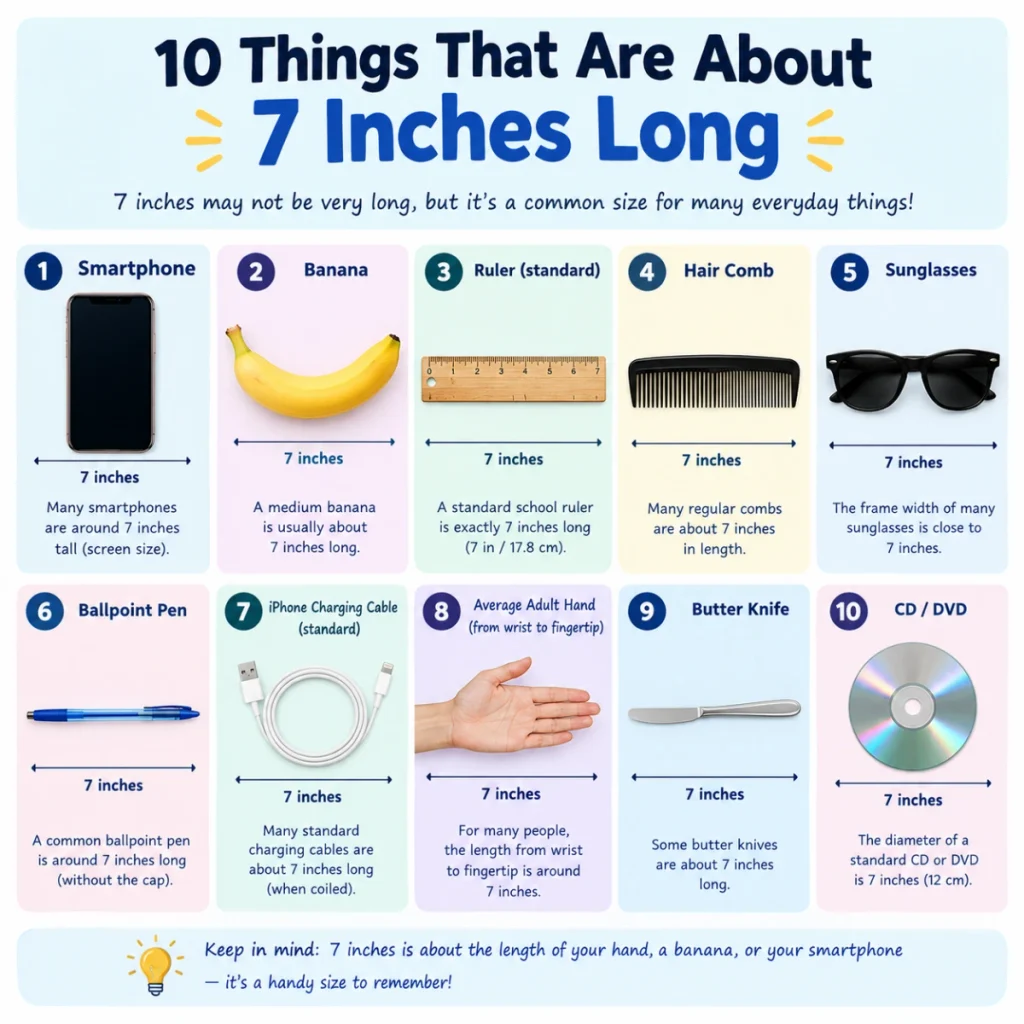
Many everyday items can help you picture a length of 7 inches. The examples below include objects with a known 7-inch dimension and others that may be approximately this long.
1. A 7-Inch Vinyl Record
A 7-inch vinyl record is one of the clearest examples of this measurement. Its nominal diameter is 7 inches, which equals 17.78 centimeters.
These records are commonly used for music singles and shorter releases. To visualize the measurement, imagine measuring straight across the record through its center, from one outer edge to the opposite edge.
Unlike many everyday comparisons, this example refers to a recognized record size rather than an estimate based on a typical object’s appearance.
2. A 5 × 7-Inch Photograph
A photograph measuring 5 × 7 inches has a longer side of exactly 7 inches and a shorter side of 5 inches. The longer side is equivalent to 17.78 centimeters.
This is a convenient comparison because printed photographs and photo frames are common household items. If you have a photograph in this format, its longer edge can help you picture 7 inches.
Keep in mind that a frame’s outer dimensions may be larger than the photograph itself because of the border and frame material.
3. A Standard Pencil
A pencil can provide a familiar reference for visualizing 7 inches. Many pencils are close to this length, but their dimensions vary depending on their design, brand, and whether they have been sharpened.
A new wooden pencil may be longer than a short or heavily used pencil. For that reason, it is best to measure the pencil you have rather than assume every pencil measures exactly 7 inches.
If your pencil is close to 17.78 cm, it can serve as a convenient everyday comparison.
4. An Adult Toothbrush
Many adult toothbrushes are approximately 7 inches long, although some models are shorter or longer. The total measurement includes the handle and brush head.
To check the length, place the toothbrush on a flat surface and measure from the end of its handle to the tip of the bristles.
A toothbrush can be a useful comparison because it is an object people often have nearby. However, different designs and brands can produce noticeable differences in overall length.
5. A Medium Banana
A medium banana may measure around 7 inches long, depending on its variety and size. Since bananas have a natural curve, their measured length can differ according to the method used.
Measuring along the curve provides a different result from measuring a straight line between the two ends. This makes a banana a helpful visual example, but not an exact reference.
If you are comparing a banana with 7 inches, treat the result as an estimate rather than a standard measurement.
6. A TV Remote Control
Some compact television remote controls are close to 7 inches long. Other models may be shorter or longer, depending on their shape, button layout, and intended use.
A remote control is a practical example because it is easy to hold and compare with a ruler. Measuring it from one end to the other will show whether it is close to 17.78 cm.
Avoid assuming that every remote control has the same length, particularly when comparing different television brands.
7. A Dinner Fork
Some dinner forks measure approximately 7 inches from the tips of the prongs to the end of the handle. Larger forks and specialty cutlery may have different dimensions.
You can use a fork to visualize this measurement by placing it beside a ruler or a line marked at 7 inches. This comparison is particularly useful when you want to understand the length of a small object without imagining the measurement in isolation.
The exact length depends on the fork’s design and purpose.
8. A Small Paperback Book
Some paperback books are approximately 7 inches tall. However, book sizes vary by publisher, edition, and format, so this comparison will not apply to every paperback.
To check the height, measure from the bottom edge to the top edge of the closed book. This is different from measuring the book’s width or thickness.
A paperback near 7 inches tall can provide a useful visual reference for 17.78 cm.
9. A Compact Hairbrush
A compact hairbrush may be close to 7 inches long, especially if it is designed for travel or everyday use. Larger brushes and different handle shapes can change the overall measurement.
Measure from the end of the handle to the opposite end of the brush to determine its total length. The bristles’ length alone does not represent the full measurement.
A hairbrush can help you picture 7 inches, but it should be considered an approximate comparison unless its dimensions have been checked.
10. A Small Kitchen Knife
Some small kitchen knives measure around 7 inches in total length, including the handle and blade. However, knives come in many sizes, and the blade itself may be substantially shorter than the full knife.
When comparing the measurement, distinguish between the blade length and the total length. These describe two different dimensions.
Always handle a knife carefully when measuring it, and keep the blade pointed away from you.
How to Measure 7 Inches Without a Ruler
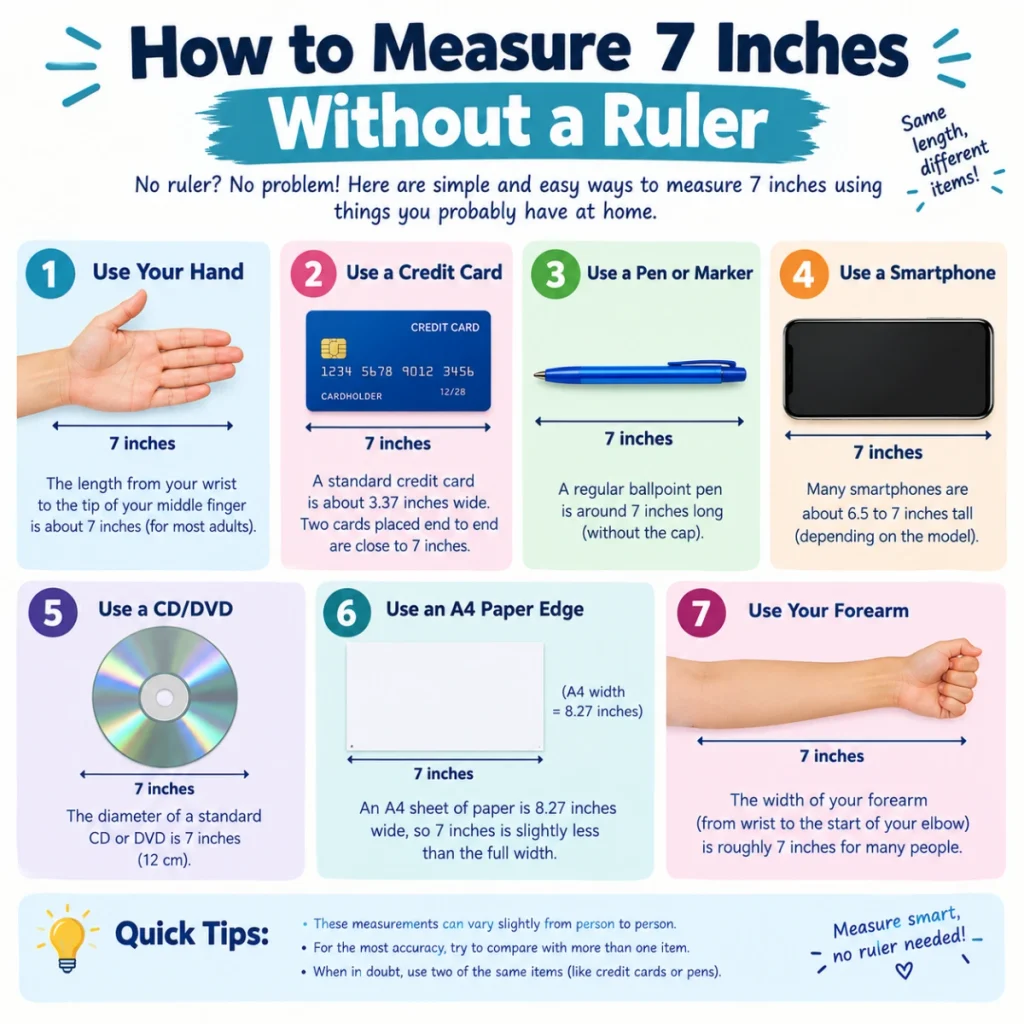
If you do not have a ruler available, you can still estimate 7 inches using familiar objects. These methods are useful for quick checks, but they are less reliable than a proper measuring tool.
Use a 5 × 7-Inch Photograph
If you have a photograph printed at 5 × 7 inches, its longer side provides a direct reference for 7 inches. This works as long as the print has not been resized or cropped in a way that changes its dimensions.
You can compare another object against the photograph’s longer edge to estimate its length.
Use a 7-Inch Vinyl Record
A standard 7-inch vinyl record has a nominal diameter of 7 inches. Measuring across the center gives you a useful reference for this length.
Make sure you compare the full diameter rather than the smaller label in the center of the record.
Measure Your Hand
Your hand can provide a personal reference, but hand sizes vary significantly. You can measure from your wrist crease to the tip of your middle finger or check the distance across your hand.
If one of these measurements is close to 7 inches, it may help you estimate similar lengths in the future. However, your hand should not be treated as a universal measurement.
Use a Printable Measurement Line
You can draw a straight line on paper and check it against a ruler when one becomes available. Alternatively, print a measurement guide at its actual size.
If you print a guide, use the 100% or Actual Size setting. Options such as “Fit to Page” can change the dimensions and make the printed measurement inaccurate.
Try a Smartphone Measuring App
Some smartphones have measuring apps that estimate distances using the camera. These tools may help you measure an object when a ruler is unavailable.
Results can vary depending on camera positioning, lighting, and the object’s shape. For an important measurement, confirm the result with a physical ruler or measuring tape.
Frequently Asked Questions
How many centimeters is 7 inches?
Seven inches equals 17.78 centimeters. To convert inches to centimeters, multiply the number of inches by 2.54.
Is 7 inches longer than half a foot?
Yes. Half a foot is 6 inches, so 7 inches is exactly 1 inch longer than half a foot.
How many millimeters are in 7 inches?
Seven inches equals 177.8 millimeters. Multiply 7 by 25.4 to convert inches into millimeters.
Is 7 inches considered big?
It depends on the object being measured. Seven inches is a moderate length for a handheld item, but it is relatively small for furniture or large household objects.
How long is 7 inches compared with a ruler?
Seven inches covers a little more than half the length of a standard 12-inch ruler. The remaining length is 5 inches.
Is a 7-inch screen actually 7 inches long?
Not necessarily. Screen sizes are generally measured diagonally from one corner to the opposite corner. The actual width and height depend on the screen’s aspect ratio and design.
What is the easiest way to visualize 7 inches?
A 7-inch vinyl record provides a useful reference because its nominal diameter is 7 inches. The longer side of a 5 × 7-inch photograph is another direct comparison.
How can I measure 7 inches accurately?
Use a ruler or measuring tape and align the object with the zero mark. Measure to the 7-inch mark rather than estimating the length by eye.
Final Thoughts
Final Thoughts
Seven inches equals 17.78 centimeters, 177.8 millimeters, and approximately 0.58 feet. It is slightly longer than half a foot and becomes easier to visualize when compared with familiar everyday objects.
A 7-inch vinyl record and the longer side of a 5 × 7-inch photograph are useful references. Pencils, toothbrushes, and remote controls can also help you estimate this length, although their dimensions vary.
When accuracy matters, use a ruler or measuring tape instead of relying on visual estimates. Understanding measurement standards can also help you convert between inches, centimeters, millimeters, and other units more confidently.

Oliver Bennett is a dedicated writer passionate about measurements, dimensions, and practical size guides. Through InchesLines, he helps readers understand measurements, explore inch conversions, and find accurate dimensions for everyday needs.