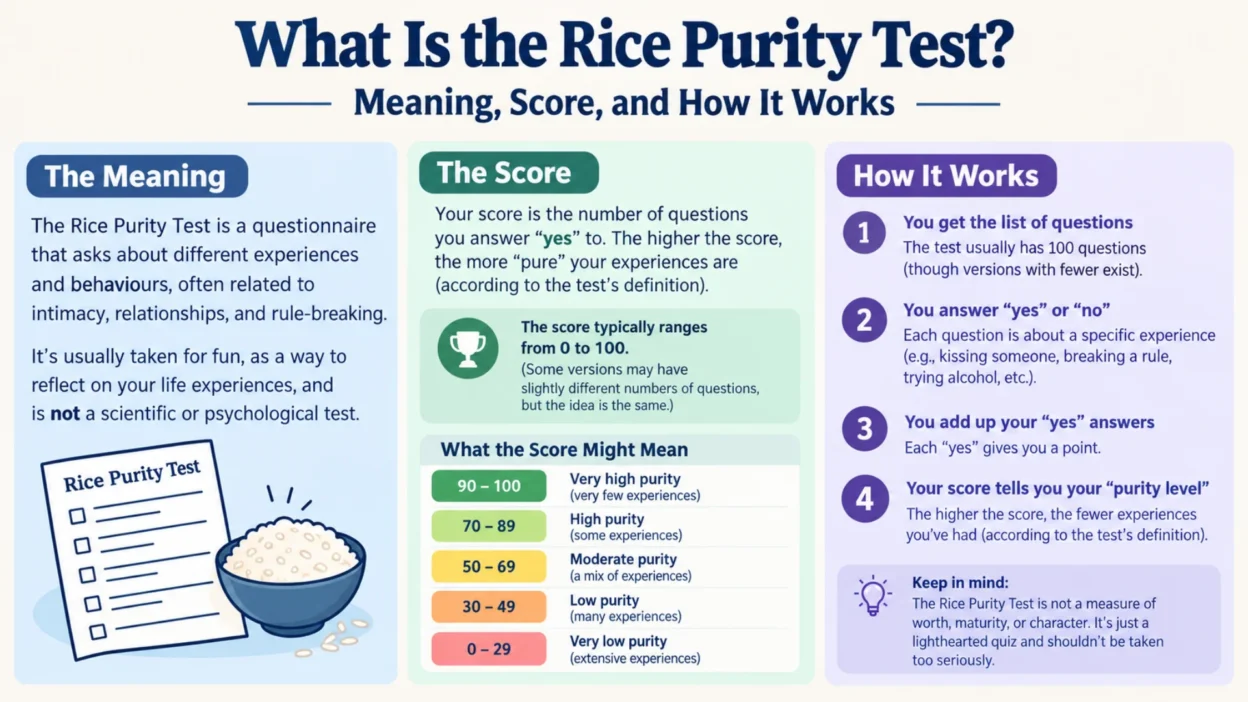
The Rice Purity Test is a self-assessment quiz that measures a person’s experiences across different areas of life, including relationships, social activities, and personal behavior. It is commonly shared among college students and friends as a fun way to compare experiences.
The test usually contains 100 yes-or-no questions. Your final score ranges from 0 to 100, with a higher score generally indicating fewer of the experiences listed in the quiz. However, the result is not a scientific measurement of someone’s character, maturity, or worth.
What Is the Rice Purity Test?
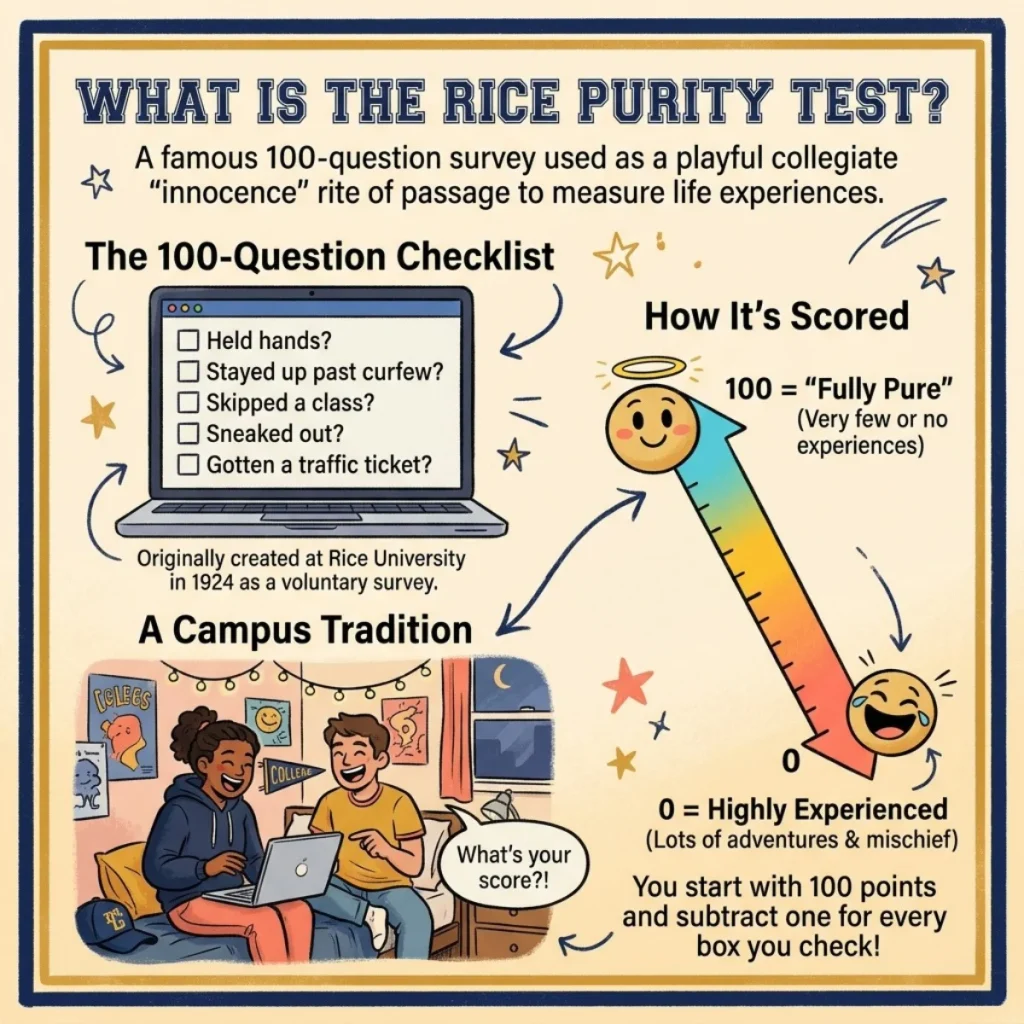
The Rice Purity Test originated at Rice University in Houston, Texas. It became popular as a social activity, particularly among university students who wanted to compare their life experiences.
The test includes questions about different experiences, such as dating, relationships, alcohol, and other personal or social activities. Participants answer each question honestly based on their own experiences.
It is intended mainly for entertainment and self-reflection. It should not be treated as a psychological assessment or a formal measure of someone’s personality.
How Does the Rice Purity Test Work?
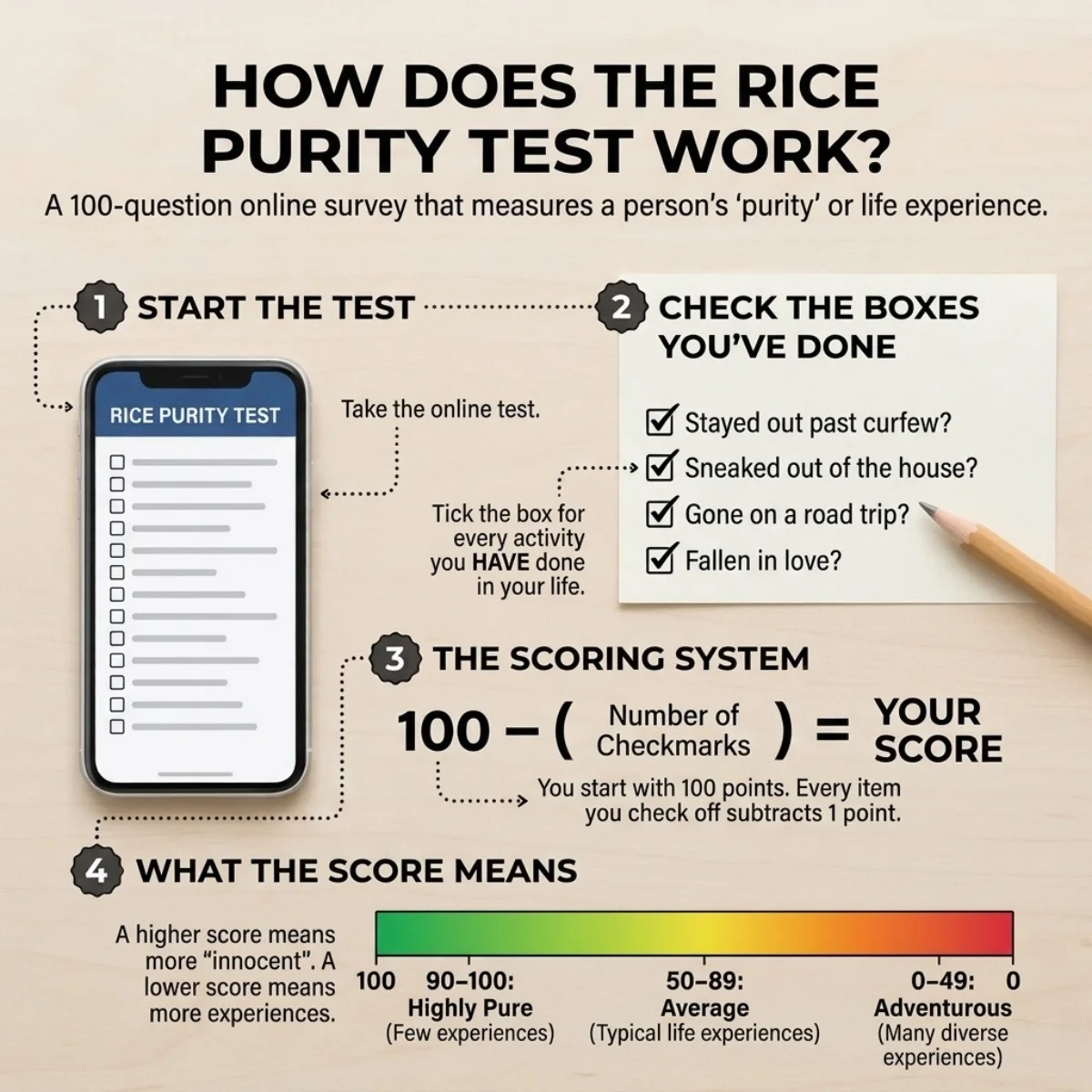
The test is simple to complete. You read a list of questions and indicate which experiences you have had.
The traditional version includes 100 questions. Each question generally asks whether you have experienced a particular activity or situation.
Here’s how the process works:
- Open a Rice Purity Test questionnaire.
- Read each question carefully.
- Select the questions that describe experiences you have had.
- Leave unselected the questions that do not apply to you.
- Submit your answers to calculate your score.
Your score is based on the number of experiences you have not selected. The exact interface and scoring presentation may vary between websites offering the test.
What Does Your Rice Purity Test Score Mean?
The Rice Purity Test score generally ranges from 0 to 100. A higher score means you have reported fewer of the listed experiences, while a lower score means you have reported more.
The following table offers a general interpretation. These ranges are informal examples, not official categories.
| Score range | General interpretation |
|---|---|
| 90–100 | Fewer experiences listed on the test |
| 70–89 | Some experiences reported |
| 50–69 | A broader range of experiences reported |
| 25–49 | Many listed experiences reported |
| 0–24 | Most listed experiences reported |
Your score does not determine whether you are a good person, a bad person, innocent, mature, or experienced. People have different backgrounds, values, opportunities, and personal boundaries.
Is a High or Low Rice Purity Score Better?
Neither score is automatically better.
A high score generally means you have experienced fewer of the activities mentioned in the questionnaire. A low score usually means you have experienced more of them.
Some people take the test with friends for fun, while others use it to reflect on their own experiences. There is no requirement to achieve a particular score.
Remember: Your personal choices and boundaries matter more than a number on an online quiz. You should never feel pressured to participate in an activity just to change your score or fit in with others.
What Types of Questions Are on the Rice Purity Test?
The traditional test covers several categories of personal and social experiences. The exact wording depends on the version you use.
Common topics include:
- Dating and relationships: Experiences involving romantic relationships and dating.
- Social activities: Situations involving parties and social gatherings.
- Alcohol and substances: Questions about certain substance-related experiences.
- Personal behavior: Questions about different life experiences and decisions.
- Intimacy: Questions about romantic and intimate experiences.
- Rules and boundaries: Questions involving particular choices or situations.
Some questions concern sensitive topics. You can decide whether you are comfortable answering them, and you do not need to share your answers with anyone else.
Is the Rice Purity Test Accurate?
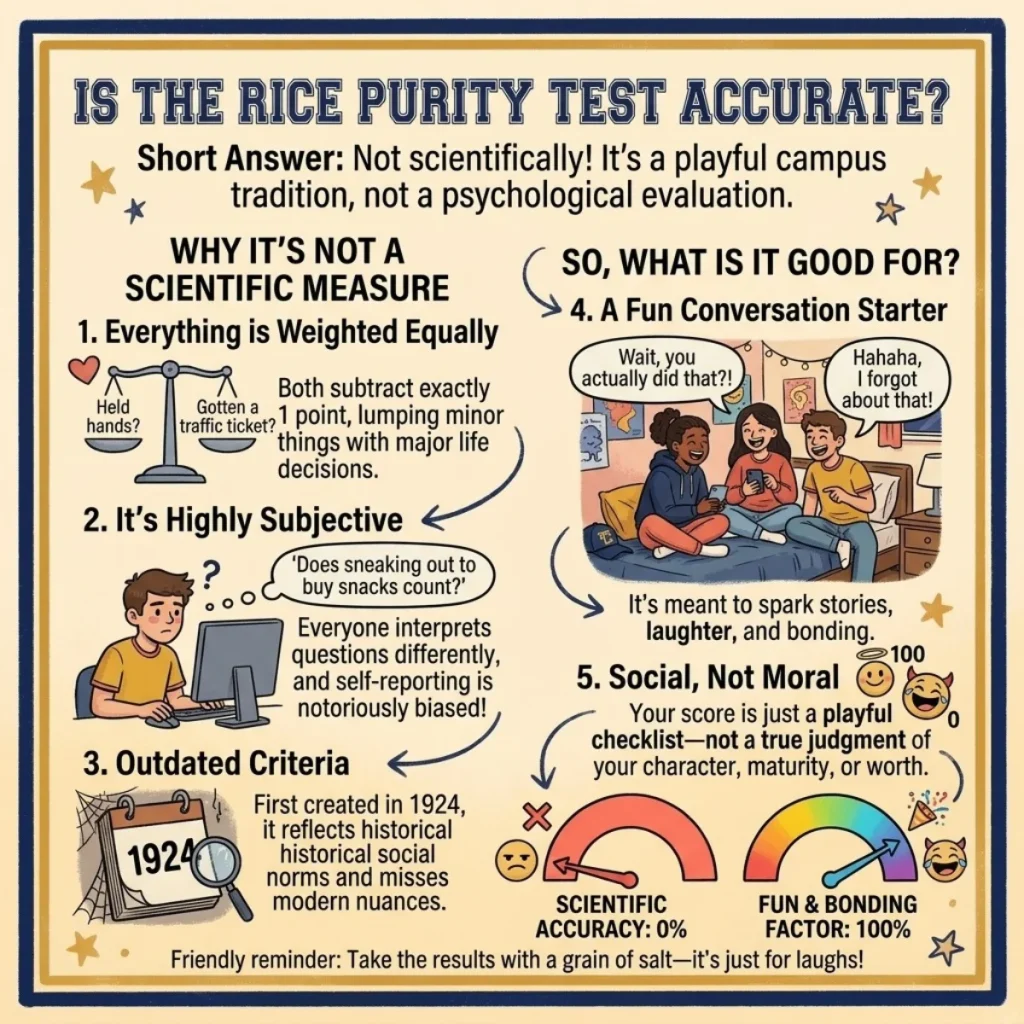
The Rice Purity Test is not a scientifically validated personality test. It provides a simple numerical summary of answers to a set of questions, rather than a complete picture of someone’s life.
Its accuracy also depends on how honestly and consistently someone answers. Different websites may use modified questionnaires, which can make scores difficult to compare.
The test cannot reliably measure:
- Your personality or intelligence
- Your emotional maturity
- Your moral values
- Your relationship skills
- Your mental health
- Your overall life experience
Treat the result as an informal quiz rather than a formal assessment.
Why Is the Rice Purity Test So Popular?
The test has become popular because it is easy to complete and provides a score that people can discuss with friends.
Several factors contribute to its popularity:
Easy to take: Most versions require only a few minutes and simple answers.
Social comparison: Friends sometimes compare their scores as a conversation starter.
Curiosity: People may want to understand what the questions cover or how the scoring works.
Online sharing: Scores and discussions can spread quickly through social media and student communities.
However, sharing your score is optional. You can complete the test privately without revealing personal information.
Is the Rice Purity Test Anonymous?
That depends on the website hosting the questionnaire. The traditional test can be completed without necessarily providing your name, but third-party websites may collect technical information or use cookies.
Before completing an online version, check its privacy policy. Avoid entering your full name, phone number, address, or other unnecessary personal details.
If you are using the test with friends, remember that you are not obligated to reveal your score or explain your answers.
Frequently Asked Questions
1. What is the Rice Purity Test used for?
It is mainly used as an informal quiz to reflect on personal experiences and compare scores with friends. It is not intended to diagnose or assess someone’s character.
2. What is the highest Rice Purity Test score?
The highest score is generally 100. It indicates that none of the listed experiences were selected.
3. What is the lowest Rice Purity Test score?
The lowest score is 0. In the traditional scoring format, it indicates that all listed experiences were selected.
4. Is a score of 100 good?
A score of 100 means you reported none of the experiences listed in that version of the test. It is not a measure of your worth or a guarantee of any particular personality trait.
5. Is a score of 50 bad?
No. A score of 50 simply reflects your answers to the questionnaire. It does not mean you are a bad person or that your experiences are better or worse than someone else’s.
6. Can teenagers take the Rice Purity Test?
Some versions contain questions about adult or sensitive topics. Teenagers should consider the content carefully, use age-appropriate judgment, and avoid websites that request unnecessary personal information.
7. Do I have to share my score?
No. Your answers and score are personal. You can keep them private even if your friends are comparing their results.
8. Is the Rice Purity Test scientific?
No. It is an informal self-assessment quiz, not a standardized psychological instrument supported by scientific validation.
Conclusion
The Rice Purity Test is a popular 100-question quiz that summarizes selected personal experiences in a score from 0 to 100. A higher score generally means fewer listed experiences, while a lower score means more. Although it can be an entertaining conversation starter, it cannot measure someone’s character, maturity, or personal value. Everyone has a different life story, and there is no ideal score that you need to achieve. To explore the university behind the test, visit the history of Rice University.

Oliver Bennett is a dedicated writer passionate about measurements, dimensions, and practical size guides. Through InchesLines, he helps readers understand measurements, explore inch conversions, and find accurate dimensions for everyday needs.