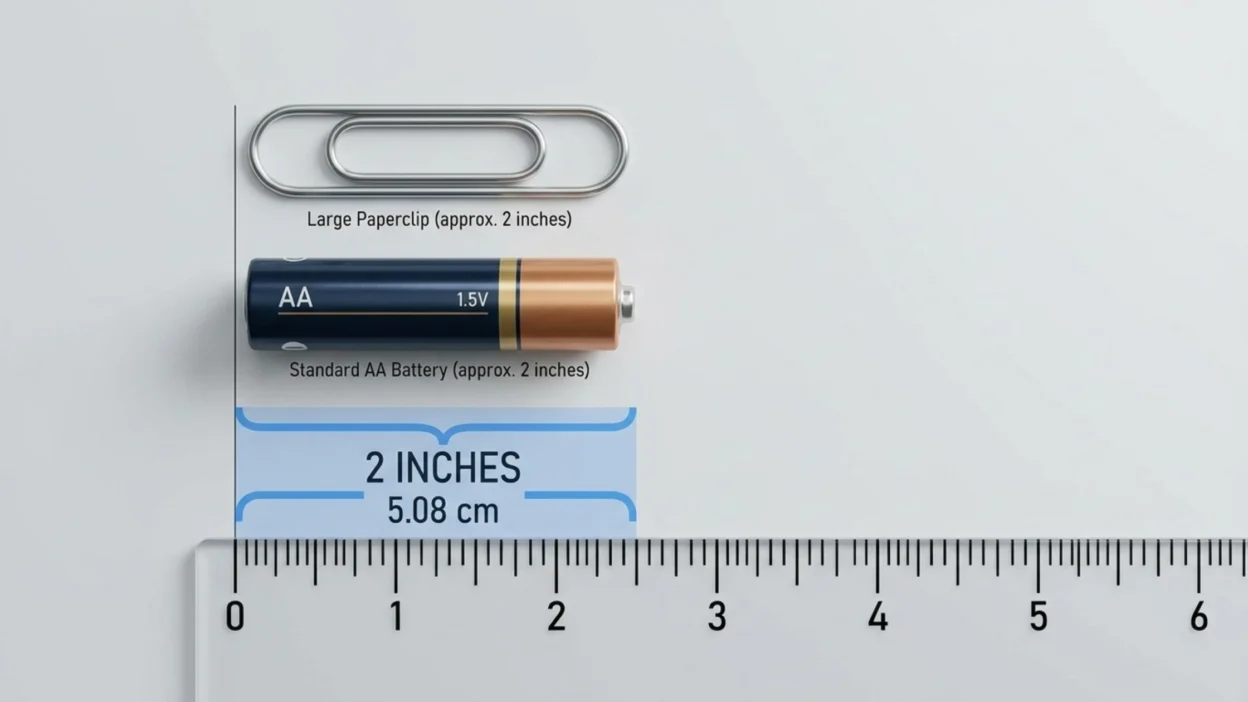
Two inches may seem like a small measurement, but it is useful when measuring small objects, checking product dimensions, or comparing everyday items. If you do not have a ruler nearby, familiar objects can help you picture how long 2 inches really is.
Two inches equals 5.08 centimeters, 50.8 millimeters, or approximately 0.167 feet. It is one-sixth of a foot and can be easier to understand when compared with small household objects.
In this guide, you will learn how big 2 inches is, how to convert it into different units, and which everyday objects can help you visualize this length.
How Long Is 2 Inches?
Two inches measures exactly 5.08 centimeters, making it just slightly longer than 5 cm. It is also equal to 50.8 millimeters and one-sixth of a foot.
To visualize this length, imagine a line stretching from zero to the 2-inch mark on a ruler. It is a relatively short distance, similar to the length of some small accessories, buttons, and compact objects.
Keep in mind that an object’s length, height, width, and thickness describe different dimensions. A product that is 2 inches wide may be much longer in another direction.
2 Inches Conversion Chart
The table below shows how 2 inches converts into several common units of measurement.
| Measurement Unit | Equivalent |
|---|---|
| Inches | 2 inches |
| Feet | 0.1667 feet |
| Centimeters | 5.08 cm |
| Millimeters | 50.8 mm |
| Meters | 0.0508 m |
| Yards | 0.0556 yards |
These conversions are helpful when reading product specifications, following craft instructions, comparing measurements, or shopping on websites that use different measurement systems.
How to Convert 2 Inches Into Other Units
Converting 2 inches is simple when you know the conversion factors.
- Inches to centimeters: Multiply 2 by 2.54 to get 5.08 cm.
- Inches to millimeters: Multiply 2 by 25.4 to get 50.8 mm.
- Inches to feet: Divide 2 by 12 to get approximately 0.1667 feet.
- Inches to meters: Multiply 2 by 0.0254 to get 0.0508 meters.
- Inches to yards: Divide 2 by 36 to get approximately 0.0556 yards.
Remember that one inch equals 2.54 centimeters. You can use this conversion factor to calculate other inch measurements quickly.
What Does 2 Inches Look Like?
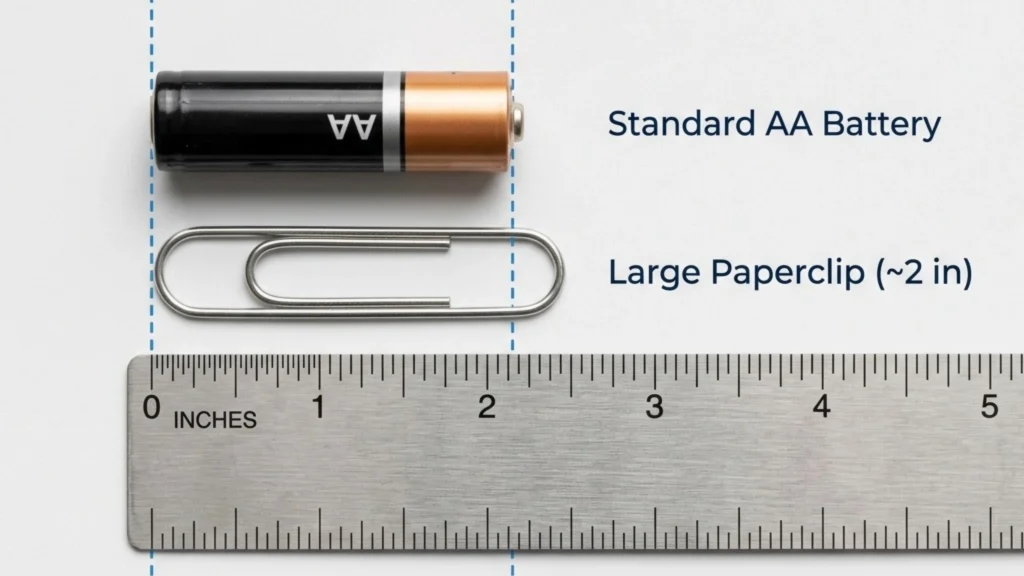
The easiest way to understand 2 inches is to compare it with a familiar object. For example, a standard US quarter-dollar coin is approximately 0.955 inches in diameter, so two quarters placed side by side measure close to 2 inches across.
Small objects such as paper clips, buttons, and USB connectors can also help you visualize this length. However, their sizes vary, so they are better for rough comparisons than precise measurement.
If you need an accurate result, use a ruler or measuring tape. Everyday objects are useful for developing a sense of scale, but their dimensions should not be assumed to be exact.
10 Things That Are About 2 Inches Long
Several everyday objects can help you picture a length of 2 inches. Some examples have a known standard dimension, while others are approximate and depend on their design or size.
1. Two US Quarter Coins Side by Side
A US quarter-dollar coin has a diameter of approximately 0.955 inches. When you place two quarters side by side, their combined width is about 1.91 inches.
This makes two quarters a convenient visual reference for a length close to 2 inches. They are slightly shorter than 2 inches, so use them as an estimate rather than an exact measuring tool.
2. A Small Paper Clip
Some small paper clips are close to 2 inches long, although many common paper clips are shorter. Their dimensions depend on the style and manufacturer.
If you have a paper clip nearby, lay it straight on a flat surface and compare it with a ruler. This will show whether it is a useful reference for 5.08 centimeters.
3. A Large Button
Some large clothing or craft buttons measure around 2 inches across. Smaller shirt buttons can be much less than an inch in diameter.
A large button can help you picture this measurement, especially when comparing the width of small circular objects. Measure straight across the center to determine its actual diameter.
4. A Small USB Connector
The metal connector on some USB cables is around an inch or less in length, while the surrounding housing can make the entire connector area longer. Some compact connector assemblies may approach 2 inches.
Because connector designs differ, this is only an approximate comparison. Measure the complete section you want to compare rather than assuming all USB connectors have the same dimensions.
5. A Short Pencil Eraser
Some small replacement erasers or compact eraser blocks are close to 2 inches long. Standard pencil-top erasers are usually much smaller.
An eraser is an easy object to compare against a ruler because it generally has straight edges. Its usefulness as a reference depends on its actual dimensions.
6. A Small Hair Clip
Some small hair clips measure approximately 2 inches from end to end. Larger claw clips and longer styling clips can be considerably bigger.
Place the clip on a flat surface and measure its full length to check whether it is close to 5.08 cm. Different shapes may make visual estimates less reliable.
7. A Key Fob
Some compact key fobs are about 2 inches long, although car key fobs and electronic remotes vary widely in size.
Their overall length may include a metal key ring or attachment point, so decide which part you are measuring before comparing it with 2 inches.
8. A Small Craft Brush
The handle or brush head of a small craft brush may measure close to 2 inches, depending on the type. The entire brush is generally longer.
This example is useful when you need to visualize the length of a small tool. Measure the specific section rather than treating the brush’s total size as a standard 2-inch dimension.
9. A Compact Lip Balm Tube
Some compact lip balm containers are close to 2 inches long, while many standard tubes are longer. Packaging and product design affect the overall dimensions.
If you have a lip balm tube nearby, compare its length with a ruler. It may be a helpful reference for a small object measuring around 5 cm.
10. A Small Decorative Magnet
Some small refrigerator magnets measure approximately 2 inches across or along their longest side. Their shapes and dimensions vary depending on the design.
A square magnet measuring 2 inches on each side can be a particularly easy comparison because its edges provide a clear reference. Check the actual dimensions if you need precision.
How to Measure 2 Inches Without a Ruler
If you do not have a ruler, you can estimate 2 inches using familiar objects or a measuring tool on your phone. These methods are useful for quick checks, but they are not all equally accurate.
Use Two US Quarter Coins
Two US quarter-dollar coins placed side by side measure approximately 1.91 inches across. This is close to 2 inches, although the small difference matters when precise measurements are required.
The comparison works best when the coins are placed edge to edge without overlapping.
Use a Printable Measurement Line
Draw or print a line that measures 2 inches from end to end. If you print a measurement guide, choose 100% or Actual Size rather than “Fit to Page.”
Printer scaling can change the length of the line. Check the printed measurement with a physical ruler before relying on it.
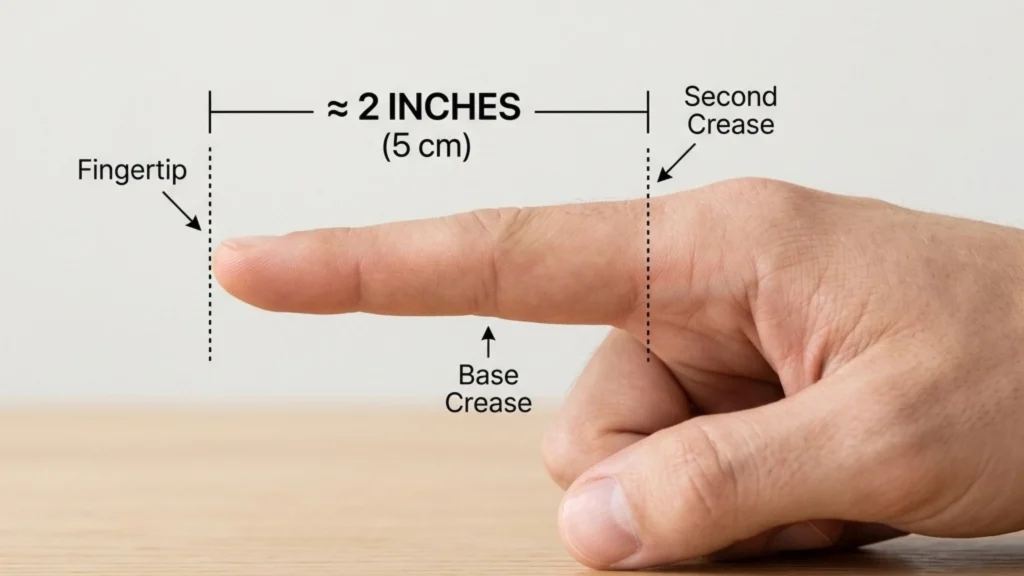
Measure Your Finger
Your finger can provide a rough personal reference, but finger widths and lengths differ from person to person. Do not assume a finger or finger joint is exactly 2 inches long.
If you measure your finger once, you can use that measurement for future estimates, provided you remember that it is specific to you.
Use a Smartphone Measuring App
Some smartphones include camera-based measurement tools that estimate the dimensions of objects. These can help when you do not have a ruler nearby.
Results may vary with camera positioning, lighting, and object shape. For accurate measurements, confirm the result with a physical ruler or measuring tape.
Frequently Asked Questions
How many centimeters is 2 inches?
Two inches equals 5.08 centimeters. Multiply the inch measurement by 2.54 to convert inches into centimeters.
How many millimeters are in 2 inches?
Two inches equals 50.8 millimeters. One inch equals 25.4 millimeters, so multiplying 25.4 by 2 gives 50.8 mm.
Is 2 inches the same as 5 centimeters?
Not exactly. Two inches equals 5.08 centimeters, which is 0.08 cm longer than 5 centimeters.
How much of a foot is 2 inches?
Two inches is one-sixth of a foot because a foot contains 12 inches. As a decimal, 2 inches equals approximately 0.1667 feet.
What everyday object is close to 2 inches?
Two US quarter-dollar coins placed side by side measure about 1.91 inches across. Some large buttons, compact accessories, and small craft items may also be close to 2 inches.
Is 2 inches considered small?
It depends on what you are measuring. Two inches is a short length for many household objects but can be substantial for a button, small accessory, or compact component.
How can I measure 2 inches accurately?
Use a ruler or measuring tape and align the object with the zero mark. Measure to the 2-inch mark for a reliable result.
What is 2 inches in meters?
Two inches equals 0.0508 meters, or 5.08 centimeters.
Final Thoughts
Two inches equals 5.08 centimeters, 50.8 millimeters, and approximately 0.167 feet. Although it is a short measurement, it is useful for understanding the dimensions of small accessories, craft supplies, and everyday household objects.
Two US quarter-dollar coins placed side by side provide a convenient comparison, measuring approximately 1.91 inches across. Other objects, such as buttons, paper clips, and compact accessories, can also help you visualize this length, but their sizes vary.
For reliable results, use a ruler or measuring tape instead of relying only on visual estimates. You can also explore metric conversion methods to better understand how inches relate to centimeters, millimeters, and other units.

Oliver Bennett is a dedicated writer passionate about measurements, dimensions, and practical size guides. Through InchesLines, he helps readers understand measurements, explore inch conversions, and find accurate dimensions for everyday needs.